Friday, 29 June 2012


Wednesday, 27 June 2012
Marx & Monsters: A Radical Leftist Fantasy Sandbox
 |
| Credit: anndr on deviantart |
Narratives that build from this perspective tend to resonate with our inner sympathetic selves. It's no coincidence that most great adventure stories are told from the perspective of the underdog - the Rebel Alliance against the Empire, Indiana Jones against the entire Nazi Reich, and so on. Upstanding moral heroes who act to preserve the status quo make no sense in the sandbox-style gaming so beloved by the OSR, which is why dungeons tend to be filled by roguish heroes and wandering murder-hobos. Preserving the status quo is an inherently reactionary position to take up, and that's why Superman makes no sense as a hero in a sandbox - he needs an active threat, a pre-meditated plot to respond to before his narrative actually takes place.
In contrast, making the heroes of your game revolutionaries fighting against a capitalistic status quo makes perfect sense from a sandbox perspective, and from an anarchist perspective where all power is inherently suspect, your freedom fighters are the upstanding moral heroes. When you compare the problem faced by the radicals with the problem faced by your traditional sandbox rogue, the inherent similarity of the narrative becomes obvious:
The Rogue
- The world is filled with horrible monsters.
- We can't possibly kill all the monsters.
- But if we kill enough, we might save some people and get stinking rich from treasure.
- The world is ruled by the corrupt and powerful.
- We can't possibly destroy all of the corrupt power structures.
- But if we destroy enough, we might lessen the burden of the proletariat or inspire a broader revolution.
Characters & The Party
Characters should be drawn from the anarchists, the downtrodden, labour organisers, bohemians, radicals - those who have an interest in overthrowing the established power structures. In keeping with the tradition of sandbox adventurers, you don't want to create too much background for the characters, but they need to have a rationale for opposing the entrenched hierarchy. A random generator for motivations and radical affiliations is probably all you need; they can still be fighters, wizards, and rogues, but they're fighters, wizards, and rogues from outside the system's social consensus. If you have all the characters start off as members of some revolutionary cell or outlawed organisation, you've got all the motivation you need for the "adventurers" to start robbing some banks.
Experience Points & Rewards
There are a tonne of articles around the blogosphere explaining why the old-school "treasure for XP" mode of play helps deliver the ideal sandbox experience for roguish adventures. In short, the idea is that "treasure for XP" rewards inventive play in a way that "quest XP" or "monster XP" simply doesn't - you have no incentive to face that monster other than its treasure, and if you can steal or capture the treasure through other means beyond direct confrontation, you're just as well off.
This is the sort of play we want to encourage in our revolutionary PCs, but "treasure for XP" might not create the right kind of incentive. Our mystical Marxists aren't adventuring to gather wealth and become part of the establishment - they're here to bring down The Man, and liberate the proletariat from oppression. We're looking for something that encourages inventive play towards the destruction of capitalist power, not accumulation of it.
Option number one is simply to rephrase the idea of "treasure for XP". Instead of gaining XP per unit of wealth acquired, you could award XP per unit of capitalist wealth destroyed or redistributed to the oppressed classes. It's a reasonably simple method that might work if you want to keep the granularity of old-school experience systems.
A second option would be something similar to the experience model of Dungeon World, where experience is awarded based on a series of end-of-session questions answered by the party. All you have to do here is change the questions to something more appropriate for our anarchistic adventures. Instead of the questions:
- Did we learn something new and important about the world?
- Did we overcome a notable monster or enemy?
- Did we loot a memorable treasure?
- Did we learn something new and important about the City?
- Did we overcome a notable source of oppression?
- Did we lessen the burden of the proletariat?
Setting & Locales
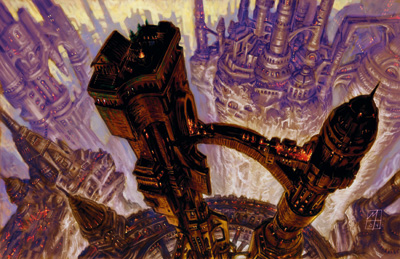
The Marxist sandbox has to be a city - in fact, it has to be the City. The traditional sandbox might be a border region perched on the edge of a monster-filled wilderness, but Marxist fantasy simply doesn't happen without industrial smokestacks belching forth noxious gasses in a city heaving with oppression, and the PCs can't be oppressed if they can simple escape the oppressor's power by leaving the city. It is a place like Sigil, or Sharn, or MoBu City - a city that's a world within itself. It should sprawl over many varied districts, each with their own unique character, some impoverished and ruined, others decadent and corrupt. Mapping the city probably defies logic and the ability of the game master, but Chris Kutalik might help. You might want to write a random generator for neighbourhoods, or steal an existing city and turn it in upon itself, using the perspective of a bottom-rung anarchist.
James Maliszewski talks about the importance of locales to the old-school method of play with his usual eloquence here; sandbox games don't run on pre-written plots. They need baroque locales for adventures to plunder and depths for adventurers to plumb. In a traditional sandbox, these are ancient tombs, lost temples, and haunted caverns. Our Marxist sandbox will instead be populated with mansions of venal judges and captains of industry, hellish factories, opulent banks, guard barracks, and corrupt temples. You can even have dungeons and caverns beneath the City, populated by the local powers of the underworld. Each locale should be ruled by some element of the oppressive hierarchy, the monstrous rulers of our anarchists' nightmarish world. In a twist on the traditional idea of the monster's lair, the various elements of a specific reactionary power's base may not all be located in one area. A bank may have branches across town, the town guards are certain to have many watch-houses, and an underworld figure may own several establishments across the City. You should treat these in some way as being part of the same adventure locale; if the players want to destroy the bankers' power, they may have to hit several different branches, or perhaps they just have to kidnap the owner from his harem-palace in the High Tower and hold him to ransom.
Monsters & Antagonists
The antagonists of your Marxist sandbox will be the varied agents of oppression. Since this is a fantasy game, you should make them as monstrous as possible; the high priest isn't just corrupt, he's a vampire. The secret police might employ mind flayers to rip the secrets from captured revolutionaries, or the underworld mob boss could literally be an ogre. Generally speaking, you can divide up your antagonists into a few categories:
- Predators: those who feed on the suffering of the populace, either literally or metaphorically. Opiates and Enforcers serve their needs, if perhaps indirectly.
- Opiates: those who try to keep the populace ignorant of their suffering.
- Enforcers: those who keep the boot on the neck those who try to rise up above their assigned station.
- Destroyers: the dark side of your revolutionary protagonists, these are not oppressors but instead destructive forces who aim to break everything down, not just the agents of oppression.
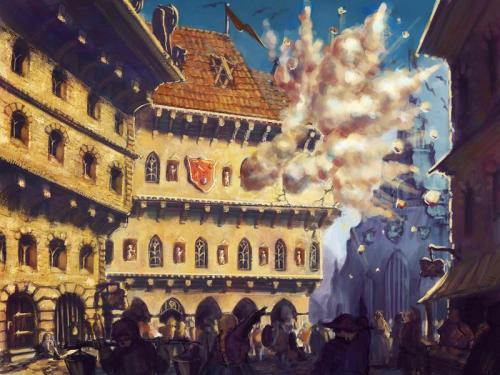
[To Coin a World] Pyresburg
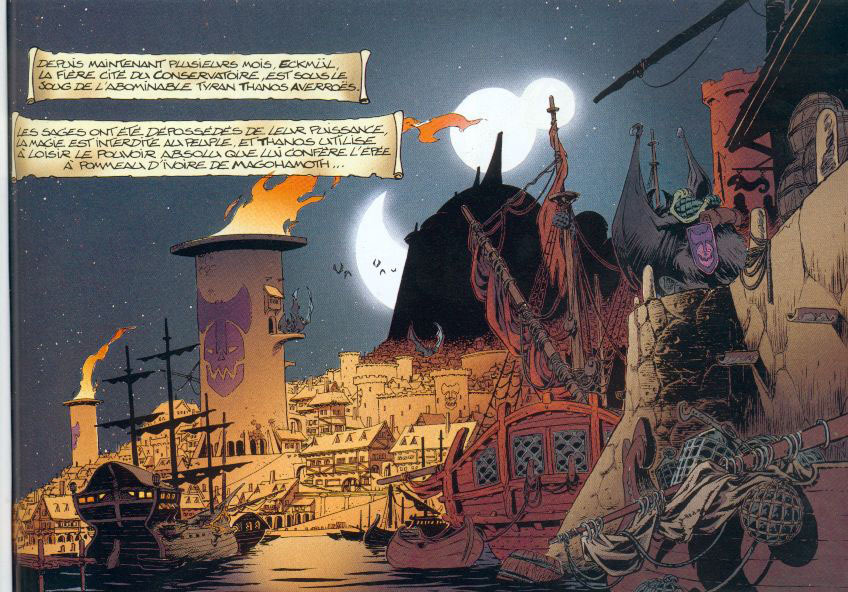 |
| A rather confused artist's impression of the city |
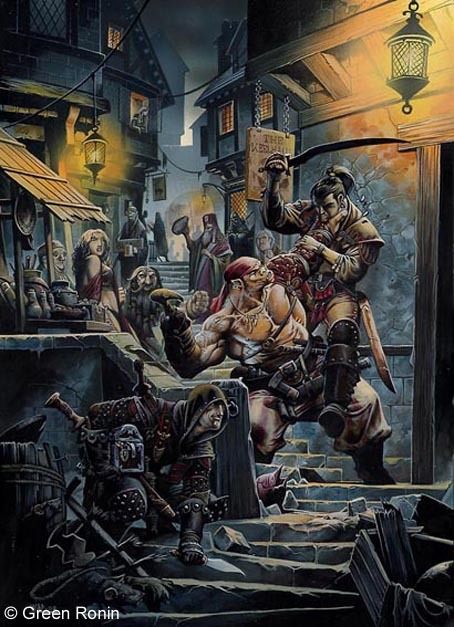 |
| A quiet evening |
 |
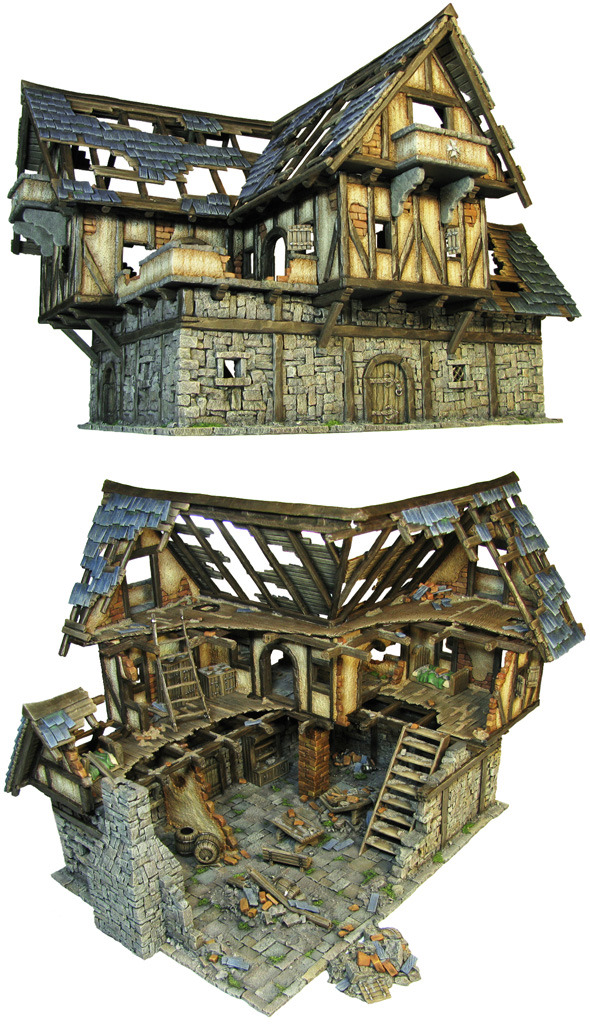
| Must be Tuesday... |
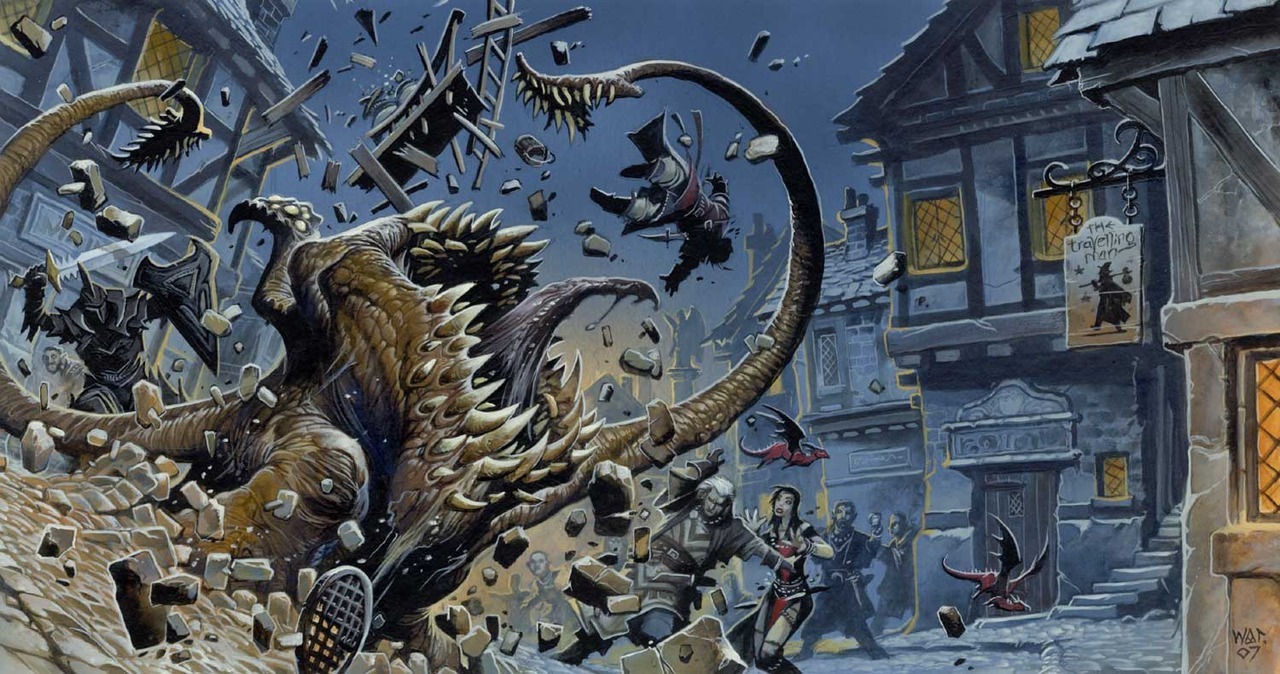 |
| Yep, definitely Tuesday. |
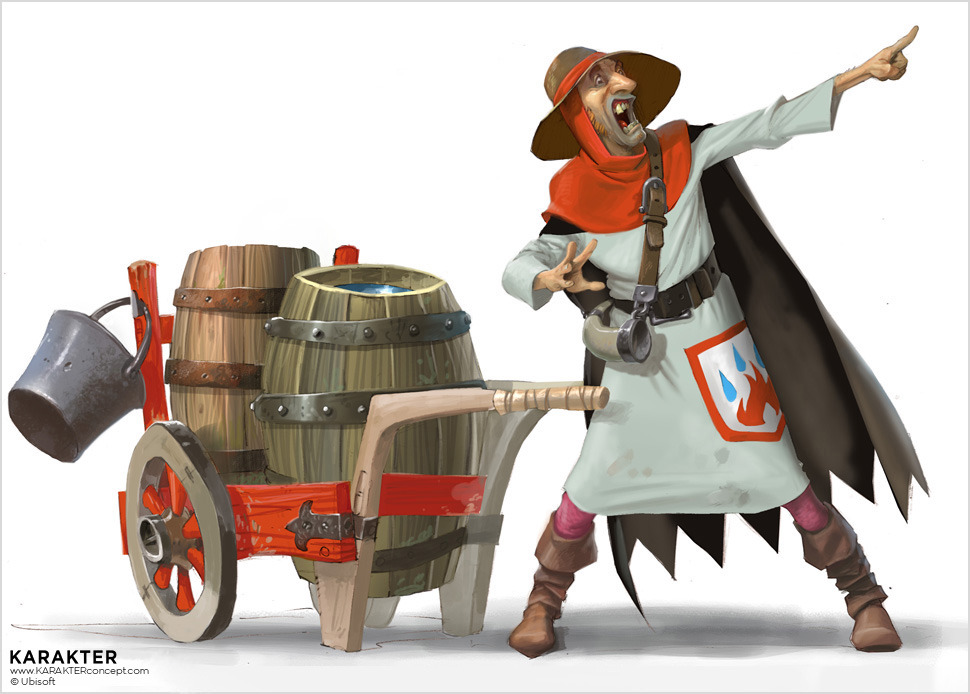 |
| Sam on a typical day. |
- Puzzled tourist from some far off land, probably about to be fleeced.
- Studded Brotherhood gang-members loitering around.
- Wannabe Red Mask running from the Watch. Is aiming more for dashing rather than fleeing.
- The Pyresbaron's bright red coach, surrounded by guards.
- Sound of a distant explosion. Anybody nearby will mutter "bloody wizards".
- Watch patrol, seemingly loaded for bear. Will be puzzled if asked why they're heavily armed, as this is standard equipment.
- Beggars. Almost certainly collecting information for somebody.
- Sam Pander and his water-cart.
- Gonzo Loudfeet nosing about.
- Weird noises from nearby drain.
- See That Random Harlot Sub-table
- Fight. 50% chance scheduled bar-fight, 50% chance flashy sword-duel.
Wednesday, 15 February 2012
[Honor + Intrigue] Demi-Human Fighting Styles
Elvish Sword-Spear: 1d6+1 damage, two-handed but without the Parry penalty usually associated with that
Friday, 3 February 2012
Nifflas
- Librarians
- Inebriates
-
Airplanes
Televisions and radios
Junkforged
Currencies - money changing mechanic
- Skywhale teeth
- Miniature gewgaws
- Sunlight phials
- Corpse fingers
- Typewriter keys
- Thrupenny
Tuesday, 31 January 2012
En-Ru-Ob-Lem
The Demonweb Pit
The
EDIT FROM JARRAH: not to be confused with M'HAHAHAHAHA, the dark elf city named after the distinctive call of the Yondan Mustache-Twirling Cookaburra. (Please feel free to delete this)
Sunday, 29 January 2012
Into the Far West
They ran a Kickstarter earlier this year to release the roleplaying game, but I wasn't able to contribute as Amazon Payments isn't easily available to me as an Australian without a credit card. I wish that either Kickstarter would start supporting PayPal, or more RPG businesses would switch to using IndieGoGo (and other PayPal supporting websites) for their crowdfunding needs.
[To Coin a World] The Dwarven Agricultural Revolution
-150 years: clever dwarven runesmith inscribes rune for sun on seeds of barley plant, leading to plants that can grow out of the sun
-100 years: sun-free barley farming becomes reasonably common in the dwarven mountain holds. surface farming communities are abandoned (ruins!), holds become more crowded as the dwarven population grows
-50 years: growing population pressures spark massive social discontent among suddenly large population of young dwarves, leading to internecine clan feuds and gross migration out of dwarven communities and into human cities
-50 years to present: human and dwarven communities become more tightly integrated thanks to migration. dwarven holds develop new mines and mining techniques that vastly increase the supply of metals across Spindewick. pri
Lawful What? An Alternative Alignment System

I have always been vaguely fascinated with the alignment system in Dungeons & Dragons; somehow, its unsatisfactory codification of ethical complexities into a simple nine-point grid holds a certain charm. You know what your Lawful Good paladin stands for, and why he has issues with the Chaotic Good bard, even though they're both on the side of the angels. The merits of the scheme are probably best expressed in Planescape, where it forms an expressive backdrop for the Great Wheel's unique cosmology and the interplay of belief and ideas.
In that vein of thought, let me present a somewhat whimsical alternative to the standard system of ethical and moral alignment, in which character's personal values and codes are presented in the form of Colours, Pieces, and Suits. It could be easily used in place of any system of codifying characters' moral or ethical alignments. A honour-bound steel-hearted paladin might be a White Knight of Diamonds, while passionately faithful paladin might be a Red Bishop of Hearts.
Colours
The Colour of one's character represents their moral perspective on the world. In a phrase, you might say it colours their definition of good and evil.
White
The colour White stands for strict benevolence, for the greater good over all other concerns and emotions. To be aligned with White is to reject the concerns of the self and focus only on the betterment of the world. White is the most moral of all the Colours because it rejects selfishness and destructive emotions.
Red
Passion and romantic idealism are embodied by Red. Red characters are lovers and warriors, fighting boldly for their ideals even in the face of reason. Red is the most moral of all the Colours because it holds love to be the most important force in the universe.
Grey
Grey is a rejection of extremes. The Greys stand for balance between competing forces; a neutral stance in a complex universe that cannot truly be understood. Grey is the most moral of all the Colours because it rejects extremes and holds to neutrality.
Yellow
In the spectrum of Colours, Yellow represents greed and self-interest, but also ambition and the seizing of opportunities. Yellow characters can be greedy mercenaries or gluttonous merchants, but they can also be ambitious artists who hold their work above all. Yellow is the most moral of all the colours because one can only be true to one's self.
Black
Black is the colour of the void and of oblivion. It is the colour of nihilists who hold that the universe is flawed and the destruction, and deserves to be corrupted or destroyed. They may not take any pleasure in suffering or destruction, but Black characters fundamentally believe in the wrongness of creation. Black is the most moral of colours because the universe deserves to be destroyed.
Pieces
Pieces refer to the relationship with power and authority; how one reacts to rules and laws, and where one believes ultimate responsibility lies.
Bishop
A Bishop places their faith solidly in the otherworldly and the divine. They hold that moral order stems from some force greater than themselves, rather than from any human ideals. Morality may come in the form of a divine text, or in the answers they hear in their personal prayers, but it is something unmistakably unworldly and immaterial.
Knight
Knights hold true to a personal code of honour and conduct, unalterable by external forces.
Rook
To be a Rook is to respect temporal authority and to hold true to one's station in society. They hold laws and traditions in high regard, and will not easily be moved to break them. Rooks make implacable servants and loyal officers, and can often be found serving in bureaucracies, or as guardians of civic order and virtue.
Jack
"No lords, no masters!" is the dying creed of the Jack. Mercurial and changeable, they cannot be pinned down to any code of conduct. Jacks are anarchists and radicals, scoundrels and renegades; found only on the edges of a society they fundamentally reject.
Queen
Some believe that authority stems fundamentally from themselves. These Queens are the ambitious and the powerful, those who believe themselves the rightful makers of law. While they may hold to some moral code, they believe themselves best placed to implement it in society.
Suits
A character's Suit represents the virtues that they value most strongly, and the means by which they seek to achieve their goals.
Diamonds
Diamonds respect excellence in all areas of life, and disdain the mediocre. No Diamond will settle for good enough; they will always push to achieve greater heights of skill or quality. The greatest gift you can give a Diamond is an exquisitely crafted tool or weapon.
Hearts
A character in the suit of Hearts will hold creativity as the greatest of virtues. To create is to be close to the divine spark, to touch the gods. They strive for innovation, beauty, and clever solutions to difficult problems. The greatest gift you can give a Heart is an expressive work of art.
Spades
Spades value diligence and simplicity; the virtue of a hard day's work. The greatest gift you can give a Spade is to satisfy simple pleasures with a hearty meal and a refreshing beverage.
Clubs
Clubs thrive on competition and in contests of skill. They seek to prove themselves superior through victory over their foes and rivals. The greatest gift you can give a Club is to challenge them to a game that tests their strengths against yours.
Jokers
The unpredictable and the unexpected are the domain of the Joker. Nothing is sacred; they push for change at every opportunity. The greatest gift you can give a Joker is something unique and surprising.
Moves:
Library Card: When you go into the library searching for information, roll +Librarian. On a 10+, you easily find a book on the topic on one of the Lower Shelves. On a 7-9, choose 1 of the follow:
- You find the book in the catalogue, but it's on one of the Upper Shelves.
- You find a book that's not quite right.
- You don't find the book, but you do find stories worth 1-name.
Wednesday, 18 January 2012
The World is a Savvyhead's Workspace
Tuesday, 17 January 2012
[To Coin a World] Languille

Languille's unique culture is the product of a centuries-long dance between the sun kingdom of Soleille and the great continent of Zwuyala. Decades ago, the city was ruled by the Solaise nobility, who formed an elegant and graceful cream on top of an underclass of oppressed Zwuyalan slaves and poor Reman laborers. But that was before Big Tuesday, and the Mort Reveille; the day the dead walked out of the river.
To escape the rage of the Sun King at the loss of one of his most prized cities, Baron Tuesday sort the protection of the Waldorf Ceasar, Emperor Otto von Karlswick, and in an unusual fit of competence and unity, the Reunited Imperium's armies found it in themselves to stop fighting against one another and smash the Sun King's armies at the Battle of Dunniewadér. And so it was that Languille passed from Soleille to the Remanschreik, and the dead went back to sleep on the river floor... for the most part.
Decades have passed, and the city has settled languidly into its new form. It may be true that Baron Tuesday is technically a lich, or a vampire, or a werewolf, or a black-hearted necromancer, or the Lord of Hell himself; but he is undoubtedly a popular ruler, at least outside of the Caged Ones or "Cajuns".
Perhaps no-one is surprised that, as the tables have turned, the newly-powerful black bourgeoise have begun to emulate their former oppressors, and the lily-white Cajun underclass have adopted several Zwuyalan traditions. The court of the Baron Tuesday seeps with all the elegance and opulence of a stately Lumiéran ball, from the overwrought corsetry to the elaborate masquerie, while the gutters and sewers of the Cagé Quartier, Cajun rootworkers delve into ancient Zwuyalana soul magick.
- Gang of wandering sailors, fresh off the boat, looking for thrills in the Lurid Quartier
- Zombi labourers clumsily unloading a merchant's cart
- Huge jazz funeral parade winding its way to Cemetery Hill
- Exquisitely beautiful painted ladies from the Red Windmill, dragging what looks to be a corpse
- Doc Delamour and his ambulatory carriage, selling his wares
- Tattooed Cajun heavies in leather jackets, enforcing a protection racket for Monsieur Brique
- Cajun rootworker disguised as a beggar
- Fetid swarm of swamp rats spilling out onto the streets
- Ancient gothic tenement collapsing into the swamp
- Sedan chair bearing the arms of the Baron Tuesday
Friday, 6 January 2012
[To Coin a World] Selected Gods
Particular thanks to Jeff Rients, from whom I pilfered Omnia and the Frog gods.
The "Good":
Lord Aon
Chief god, general grumpy sky dad and master of lightning, Aon (or another suspiciously similar deity) is worshiped in almost every human culture on the Coin, although they vary as to which goddess is his wife and queen (leading to some interesting and very heated arguments). He is typically shown with two animal companions, although what these are varies - in the Hublands, he is shown with an owl (representing cunning) and a bear (representing badassery), while in the League heartlands he’s more often shown with an eagle and a lion. Combinations of these creatures might be considered holy gifts (griffons) or profane abominations (owlbears).
Hippatara
The primary goddess of rivers and fertility around the Friendly sea, and often depicted as the wife of Aon. Hippopotami are considered holy animals by her faith, and ancient depictions of her often show her as a ponderously-proportioned anthropomorphized hippo, although the modern church frowns on this. They also frown on the worship of Khadahan (see below).
Areena
A martial goddess, Areena’s creed promotes physical and moral purity, as well as crusades against evil-doers (or, if there aren’t any evil-doers around, foreign faiths), and the justice of trial by combat. There are several orders of warriors devoted to her, in the League and in a few other countries. Invariably, they are single-gender groups. Unicorns are considered holy to her faith (whereas everybody else thinks they’re crazy and dangerous). Her followers heartily dislike the followers of Frikk.
Khadahan
Another god of rivers, as well as sunbathing and long baths, the Crocodile-headed Khadahan was mostly only worshiped in Aratha until a recent miracle at the temple in Al-Harraj unified the splintered factions of his faith, and expanded his portfolio into the realm of fertility. His faithful are now trying to spread his worship around the Friendly sea, setting up bathhouse-shrines in several major cities. As a result, they’re in direct competition with the church of Hippatara.
Frikk
Goddess of war, alcohol, and carousing in general, Frikk’s faith is main popular in the Hublands, where the locals really appreciate those things. Where Areena’s warrior-clerics promote purity and honour, Frikk’s worshippers are encouraged to brawl, drink, sing loudly, and do whatever they want so long as it doesn’t hurt anybody (unless those people are your enemies, in which case, go right ahead). Areena’s faithful are generally considered to be too uptight, and should be mocked and needled wherever possible. Chainmail is considered a gift from her to mortals, and holy folk almost always wear it (often in far smaller quantities than would be considered sensible or proper, to show their faith in the goddess).
The Bad:
The Solar Dragon
The Solar Dragon is sort of a borderline Dark God. On the one hand, his Sollais faithful abhor all other dark gods. On the other, they abhor ALL other gods, claiming them false and demonic, while periodically sacrificing virgins and enemies of the state to him (by guillotine). The Sun Prince of Solielle is considered to be his chosen leader on the mortal plane. Images of a more feathery version of the Solar Dragon have also been found on some old temples in Zwuyala.
Iggujugglyoo
Another strange and unpleasant god from the jungles of Zwuyala, Iggujugglyoo, also known as He of the Thousand Teeth is a bloodthirsty god of carnivorous dinosaurs, particularly velociraptors. Little else is known about him, except that his worshippers tend to utterly crazed.
Rzngl the Unvoweled
Depicted as an elf with the heads of two deer, each able to shoot burning rays from their eyes, this demon prince (or princess, it seems to vary) enjoys blood sacrifices in a pleasantly woodland setting.
Tormentara
A goddess of temptation and corruption, Tormentara offers mortals their wildest desire, but always finds a way to take that desire to such an extreme as to be horrifying for the unfortunate that caught her attention. Her worship is both open and prevalent amongst the Dark Elves, who hope to placate her evil whims.
Gi’Am
A demon god of earth, stone, monsters and deathtraps, Gi’Am’s dungeon-temples are a favourite target for adventuring parties. Which seems to be just the way he likes it...
The Frog Gods of Chaos
Not a single god, but a multitude of extra-dimensional amphibious horrors devoted to corrupting or destroying the universe as a whole. Thankfully, they’re so chaotic that they often work at cross-purposes.
The Peculiar:
Urinor
God of sewers and plumbing, Urinor is among the youngest gods on the Coin, his faith only having existed for a few decades, at most, since his slightly unhinged prophet, a dwarven adventurer, began spreading his word. He mostly receives prayers in the form “Oh God, I really need a privy”.
Roadael
Different cultures differ as to whether Roadael is a demigod, a saint, or an archangel, but whatever the case, he is the patron of porters, hirelings, and servants, and is said to aid the other gods in preparing for manifestation on the mortal plane.
Omnia
Goddess of Everything Not Covered By Other Gods. As a result, the things Omnia is responsible for are strange, eclectic, and generally only come up in very unusual and specific situations. Her followers are rare and a bit weird, but are mostly quite nice, except for an shadowy (and insane) cult that wishes to destroy all the other gods so as to expand her power.
Kwaaak
The Bird God of Birds, Kwaaak’s faith dwindled to almost non-existance a thousand years ago, after he went insane over wizards developing flying brooms. His church was resurrected recently by an elvish princess, and is making headway promoting him as the (much more sane and reasonable) god of airborne travel in general.
Friday, 23 December 2011
[To Coin a World] Magic Weapons of the Friendly Sea
Magebiter
Believed to be one of the many malfuctioning magic items left over from the Mage Wars, this sword seems to possess a rudimentary, animalistic personality, and a burning hatred of wizards of all stripes, seeking their deaths above all other things.
The Revenant Dirk
The origins of the Dirk are unclear, but the work of a Necromancer would not be far-fetched as an assumption. So long as the blade remains lodged in a dead body, that body will be animated and attempt to kill all living beings nearby.
Bitter Frost
Forged by the frost giants as a peace offering to the dwarven king in ages past, Bitter Frost bears the numbing cold of the wastes where it was forged, freezing any water that it contacts. It is also said to speak, and lament its own existence as a weapon of war.
The Twin Flails of Chastity
Quenched in the blood of a rabid unicorn, these two light flails are specially effective against those who could be considered loose with their affections.
Mindshiv
Found in the dungeons under the ruins of Xylarthen's Tower, this greenish hilt-less sword is said to be able to speak directly to the mind of the wielder, and sense the hostile intent of those nearby. It seeks new experiences, and if bored, may sabotage the current wielder so that it may be looted by somebody more interesting.
The Four Orcish Pirate Axes:
given as a gift by some dark and unpleasant god to the (now deceased) mutant leader of the orcish pirates known as the Bloody Axes of Powerful Killing, they appear similar in design, but each bears a different power.
The Axe of Power
This axe is able to strike with incredible force, quite out of proportion to the strength of the wielder, but is draining to use.
The Axe of Blood
Victims of this axe find their wounds bleed more freely than would be expected, and are difficult to heal.
The Axe of Killing
This axe can sense when a being is near death, and unerringly seeks to deal the final blow.
The Axe of Axes
When swung, this axe creates duplicates of itself, allowing it to be tossed at enemies as many times as the wielder wishes. The duplicates vanish after a short time.