"Well, obviously, travelling to the underworlds, the myriad lands of the dead, is very easy. Grab a knife, pick a vital organ, insert, and you're there. Travelling there in such as way that you can travel back again, that's a bit harder.
I do know of a spell that will let you do that, open a portal to the beyond. While the spell itself is not that hard, barely more difficult than a good old fireball incantation, it does have some... challenges associated with it. For starters, the spell won't work anywhere on this world. Thankfully, you can get around that by sailing to the very edge of the Coin, casting the spell so that the portal appears off the edge. Best to make sure you're going at a fair clip when you do it though. You don't want to come up short and fall into open space.
Oh, and if you think sailing a ship off the very edge of the world is difficult, just wait till you try coming back..."
Thursday, 5 July 2012


Tuesday, 3 July 2012
The Seclusium of Orphone & Other Mad Adventures
In what is sure to go down as the crazed work of a mad genius, Jim Raggi over at Lamentations of the Flame Princess has started up 19 separate crowdfunding campaigns for adventures from myriad writers across the planar spheres. Amongst the list of writers are brilliant voices like Jeff Rients, Kevin Crawford, and Anna Kreider. I hope all the adventures fund; I know a few of them will be taking money out of my wallet.
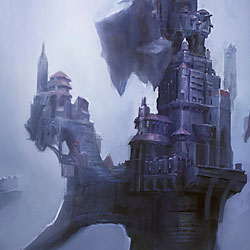
The first adventure to catch my eye was the work of Vincent Baker, designer of my favourite game in the universe, Apocalypse World: The Seclusium of Orphone. Here's the opening pitch:
The Seclusium of Orphone of the Three Visions, in which are perils and treasure both material and obscure, made vulnerable to incursion by her imprisonment in the subrealm Paume
Orphone of the Three Visions is a wizardess of restless and fitful ambition, so often seen in city market and bazaar, paced always by her velvet half-human servant and bodyguard Ioma. For decades she has kept her seclusium unassailable upon an island of three concentric gardens in the Cove of Bar's Toll, working her magics, pursuing her grandizement and mastery, forbidding all to come. Now she has ventured into the subrealm Paume, for reasons of curiosity, provocation or entrapment, and has neither returned nor left any remnant impulse of her will. Even loyal Ioma has departed for other employment.
So her seclusium stands, not vacant, but vulnerable. The wise have not yet approached it, but cast greedy and speculative looks. Who will be the first to venture an incursion? What will they find within?
The Seclusium of Orphone of the Three Visions: a system for creating an original wizard's seclusium to fit into your own game's world, campaign and level, inspired by the iconic work of Jack Vance, with notes on tone and technique, including Orphone's Seclusium itself as a complete and playable example.
And here's Vincent's initial notes on the Seclusium:
Pretty much everything Mr. Baker sets to paper is like imaginary cocaine to me, so he's already got my money. I can't wait for this to be on my table.
The first adventure to catch my eye was the work of Vincent Baker, designer of my favourite game in the universe, Apocalypse World: The Seclusium of Orphone. Here's the opening pitch:
The Seclusium of Orphone of the Three Visions, in which are perils and treasure both material and obscure, made vulnerable to incursion by her imprisonment in the subrealm Paume
Orphone of the Three Visions is a wizardess of restless and fitful ambition, so often seen in city market and bazaar, paced always by her velvet half-human servant and bodyguard Ioma. For decades she has kept her seclusium unassailable upon an island of three concentric gardens in the Cove of Bar's Toll, working her magics, pursuing her grandizement and mastery, forbidding all to come. Now she has ventured into the subrealm Paume, for reasons of curiosity, provocation or entrapment, and has neither returned nor left any remnant impulse of her will. Even loyal Ioma has departed for other employment.
So her seclusium stands, not vacant, but vulnerable. The wise have not yet approached it, but cast greedy and speculative looks. Who will be the first to venture an incursion? What will they find within?
The Seclusium of Orphone of the Three Visions: a system for creating an original wizard's seclusium to fit into your own game's world, campaign and level, inspired by the iconic work of Jack Vance, with notes on tone and technique, including Orphone's Seclusium itself as a complete and playable example.
And here's Vincent's initial notes on the Seclusium:
Later scholars will identify seven phases in the cycle of development and decline of a wizard's seclusium. It is the fifth phase, the "vulnerable," that interests us here.
Even in its "vulnerable" phase, a wizard's seclusium consists of:
- The physical structure of its seclusium proper;
- The quasi-real footprint of its magical existence;
- Its grounds, gardens, and picturesque vistas;
- Outbuildings for various purposes, both obvious and obscure;
- Passways, checkpoints, and baffles to entry, like walls, gates, paths, and vestibules;
- A position in the countryside and landscape, both physical and customary.
In its "vulnerable" phase, a wizard's seclusium nevertheless has:
- A wizard, but he or she is in some form absent;
- Guardians, but they are no longer intent;
- Portals to other wizards' seclusia;
- Portals to alternate spaces or other modes of being;
- Portals to other places of wizardly significance;
- Long term guests or prisoners of the wizard, whose needs have now gone unattended;
- Evidence or remains of previous treasure-seekers and interlopers;
- Remains of the wizard's endeavors, including dangerous failures and promising experiments;
- The wizard's trappings and treasures.
- Under some circumstances, remnants of the wizard him- or herself, embodied or dis-.
In its "vulnerable" phase, a wizard's seclusium has the attention of:
- Rival wizards hoping for spoils;
- Friendly and allied wizards, concerned for their fellow's wellbeing;
- Local kings, lords, churches, and scholars;
- Treasure seekers;
- Otherworldly entities.
When a wizard's seclusium is in its "vulnerable" phase, it shows as:
- Long inaction with an air of finality;
- Magically communicated calls for help or attention from its guests and prisoners;
- The departure of its notable guardians or servants;
- Unheeded communications, and neglected associations and obligations;
- Successful incursions.
Tone:
- The grotesque: horrific, comedic, pathetic, fantastic;
- Relativism, self-justification, delicacy, understatement, putting the best light on a bad deal;
- There are no status quos. There are catastrophes that unfold at different rates;
- Play to find out what happens.
Friday, 29 June 2012
Marx & Monsters: Burning the City
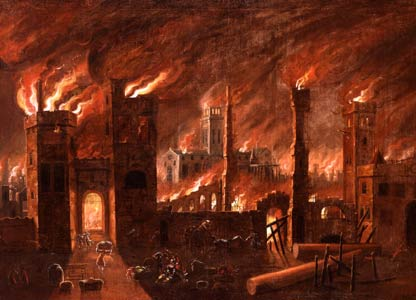

Despite all its horrors, the City is a baroque, impossible, wonderous place. Few will choose to leave it willingly; fewer still will fail to return. Choose (1d20) one, two, or three phantasmagorical traits that set the City apart from any other metropolises that have been or will ever be:
- ...it floats in the interdimensional space between the planar spheres.
- ...it consumes other cities, leaving only ruins behind.
- ...it walks across the face of the world, hauling its bulk on thousands of legs.
- ...it grows from the corpse of a dead god.
- ...it was built on the back of an immense beast.
- ...it fell from the heavens.
- ...it stands upon the border of Hell itself.
- ...it lurks within an immense dark cavern, beneath the surface of the world.
- ...it towers miles into the sky.
- ...it is an animate, living thing, with a mind of its own.
- ...it rules a vast empire built on blood and iron.
- ...it never stops raining here.
- ...it lies beyond the reach of sleep and dreams.
- ...it is filled with a thousand portals to a hundred worlds.
- ...it lies deep beneath the sea.
- ...it was built from the dreams of a lone madman.
- ...the walls between the realms of life and death are thinner here.
- ...the streets constantly shift and move, like a living labyrinth.
- ...the world has already ended, and the City is all that is left.
- ...it wraps back in upon itself like an ouroboros.
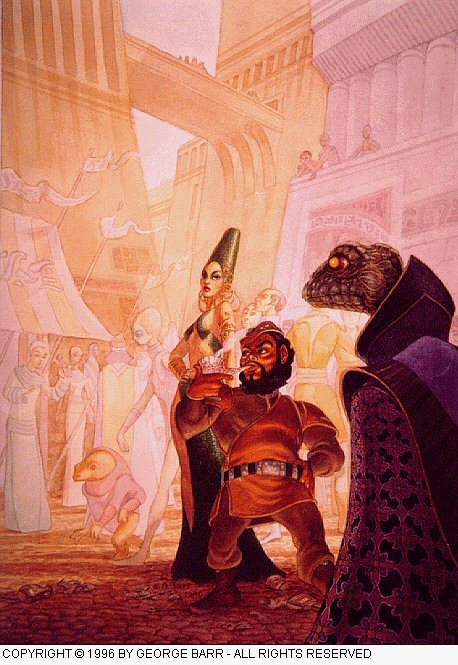
The City plays home to a host of cultures and species, a melting pot that boils everything down to its lowest common denominator. Humans call the City home, of course, but many other races do as well. Perhaps they form part of the ruling classes, perhaps they are victims of a speciest government that treats them like slaves, or perhaps they are just people. Pick (1d20) at least three non-human sapient races that make up large portions of the city's population:
- Orcs, hot-tempered, thick-skinned, and often cruel.
- Scarabae, beetle-kin with a taste for precious jewels.
- Yuan-ti, descendants of men and snakes with a poisonous bite.
- Fomorians. hulking giants with the blood of the unseelie.
- Abeil, hard-working bee folk from a distant plane of existence.
- Litorians, powerfully built leonine people with a nomadic past.
- Kobolds, scavengers with the blood of dragons in their veins.
- Minotaurs, bull-headed, stubborn, and with a penchant for labyrinths.
- Myconids, fungoid creatures who cannot form human words.
- Aranea, shape-shifting great spiders with a talent for textiles.
- Salamanders, flame-blooded and serpentine.
- Lycanthropes of several different breeds.
- Ghouls, undead scavengers with a savage hunger for flesh.
- Anubians, jackal-headed stone constructs given life through arcane means.
- Wyrmen, pigeon-like flying creatures with a rudimentary intelligence.
- Tritons, fish-kin who live in brackish coves beneath the city.
- Drow, long-banished elf-kin who abhor sunlight.
- Tieflings, humans touched with the blood of the infernal planes.
- Yoon-Suin, slug-kin, immense strength tempered only by their slowness.
- Choose any other race from your favourite compendium of creatures.
.jpg)
Corrupt plutocrats and patricians form the majority of the city's ruling class, but they do not rule alone. There are many interlocking gears in the machinery of oppression. Choose (1d10) two or three other major power groups who hold great influence over the City's leadership, either openly or in secret:
- A nest of vampires (desire: to feast off the life-force of the populace)
- The corrupt elders of a major faith (desire: to rule the hearts and minds of the populace)
- A coven of dream-witches (desire: to rule the world of dreams)
- A cabal of wizards and sorcerers (desire: to plumb the depths of knowledge)
- A cult of hedonistic demon-worshippers (desire: to revel in causing suffering)
- A powerful spirit of law (desire: to ensure obedience and conformity)
- The military leadership (desire: to wage war)
- A prominent devil with a quota to meet (desire: to ensure a healthy supply of damned souls)
- A major criminal syndicate (desire: to accumulate and hold power)
- A truly ancient dragon (desire: to hoard wealth)

Life in the City, for most of its impoverished inhabitants, is a dire struggle for one's daily bread, caught in a constant cycle of debt and near-starvation, living from one day's wage to the next, surrounded by suffering, disease, and crime. The City, however, is not content with the relatively mundane horrors of permanent crushing poverty, inescapable debts, and class-based oppression. Choose (1d12) two or three bizarre inhumanities that are imposed upon the population by the status quo:
- Constant thirst: The supply of drinkable water is controlled by plutocrats, who charge through the nose for the basic substance of life. Vast swathes of the population are constantly on the verge of death from thirst, while the wealthy cavort in bath-houses and fountains.
- Forced undeath: Necromantic rituals are used to transform corpses of the proletariat into a tireless zombie workforce. Often, labourers are worth more as dead corpses than living beings, and the truly impoverished can be forced to sell themselves into undeath to provide for their families.
- Flesh-warping: Those convicted of a crime, or who fall into bankruptcy, become the property of the City. They are subjected to flesh-warping sorcery by the City's justice system, either to shape them into better slaves, or to provide ironic punishments for their crimes. Worse yet the gardens of the truly wealthy are filled with living sculptures; sapient beings sculpted into obscene abstract bodily forms.
- Industrial sacrifice: Ritualised murder powers the City's industrial district. Criminals and debtors are the first to be fed into the maw of progress, but its hunger never yields. Sometimes, entire city blocks are cordoned off, the inhabitants carted away to be fed into some horrific eldritch machines.
- Arcane experiments: Impoverished citizens have no rights when it comes to the pursuit of arcane science. The poor are regularly subjected to horrific experiments, and most diseases that sweep through the tenements are engineered by pestilence mages from the City's most prestigious magical academy.
- Travel restrictions: Peaceful transit through the city is regulated by a series of obscure codes and travel zones. Certain classes of citizen are prohibited from travelling through certain zones at certain times, and anyone found in the wrong district at the wrong time is subject to the full horrific force of the City's justice.
- Body-theft: The wealthiest amongst the elite of the City can live forever by buying up the bodies of young criminals and debtors. Either consciousness can be transferred across bodies, leaving the poor in the broken near-corpses of City elders while they cavort in young and shapely forms, or the City's elite are in fact mental parasites that subdue the consciousness of their hosts.
- Endless conscription: The City's leaders are engaged in a constant and unyielding struggle with a foreign power, and their war machine cries out for fresh blood. Those who are conscripted and remade into soldiers or worse will never return, or at least not in any form recognizable to those who once knew them.
- Dream control: Even in deepest sleep, oppression cannot be escaped. The shadowy guardians of the City walk through the dreams of the sleepers, searching for hints of rebellion and seditious thoughts. Sleepers can even be forced to work off their debts in dream-labours towards mysterious ends.
- Memory markets: In the City, debts can be absolved and crimes forgotten in exchange for your memories, which can be sold on the open market to the highest bidder. It's not unknown for a pauper to sell the memory of their dead mother to pay for a cup of coffee, or the memory of a lost love to pay the month's rent.
- Drug-induced prayer: The alchemists and priests of the City have discovered how to produce an addictive drug known as Faith, which induces a state of heightened religious ecstasy. The prayers of a million addicted labourers are channelled as raw power into the temple-factories and eldritch workshops of the City's industrial districts.
- Blood money: The economy of the City is quite literally built on the blood of its citizenry. Pints of blood are a common unit of exchange to be bought and sold like milk or honey. Taxes, rents, and debts can be forgiven in exchange for a few minutes with a needle and bottle. In the poorer districts, pallid skin and fainting labourers are everywhere, drained of their very life-force by the machine.

Not everyone is content to allow the elites free reign, to simply lie still while they are crushed beneath the gears of capital. The City's underground is awash with revolutionary groups who aim to break the status quo, or defend the rights of the proletariat. The list below includes some of the possible groups that might make up this underground. Choose (d6) at least one revolutionary group that is actively being crushed by the enforcers of the status quo, and at least one revolutionary group whose leadership have abandoned their goals and become co-opted into the regime:
- A powerful trade union (desire: to win rights for workers).
- Anarchist street gangs (desire: to bring down the state).
- Radical street journalists (desire: to expose the truth).
- Liberation theologists, declared as heretics (desire: to protect the impoverished).
- Civil rights activists (desire: to win equality).
- Artistic revolutionaries (desire: to display the truth through art).

The leaders of the City do not generally dirty themselves with the messy business of enforcing oppressive laws and controlling the people. Stamping boots across the face of the citizenry is left to militiamen, secret police, and mercenaries hired by industrial cabals and underworld syndicates. These enforcers are well versed in the language of fists, batons, and torture, but they wield other tools as well. Choose (d10) at least two strengths of the City's enforcers:
- Ironwatch: Street-level enforcers are automata and constructs, immune to bribery and firmly under the control of the central commanders.
- Changelings: The secret police employ changelings who can take any form and infiltrate any organisation.
- Enforcer beasts: Horrific beasts are kept under control by the city guard, to be released upon criminals and rioting citizens at will.
- Noxious alchemy: The city guards have access to an array of alchemical weapons, from noxious choking gasses, to alchemical potions of strength and endurance, to batons marked with poisons that cause vomiting on contact.
- Compulsion: Secret police and other enforcers have access to charms and techniques that inflict magical compulsions upon their targets, mentally compelling them into certain actions.
- Mind flaying: With time and intimacy, agents of the regime can peel away a person's most secret thoughts and memories. The health of the prisoner is not guaranteed.
- Informants everywhere: The secret police use wealth and blackmail to maintain an incredible network of informants and double-agents, giving them eyes at every level of society.
- Judicators: The City's militia is not restrained by any formal system of justice when dealing with the proletariat; agents of the state are free to pass sentence upon offenders in situ.
- Panopticon: Most every public space, and many private ones, are laced with the scrying eyes of the secret police.
- Scent trackers: Once a target has been sighted, members of the militia are able to track them by scent through miles of winding City streets.
Finally, give the City a name, or as many names as its citizens have tongues. Haunting names that harken to lost ideals, musty names that recall ancient history, ironic names that promise a better future, or names that stir memories of revolutions past.
Next up: Mapping the City!
Wednesday, 27 June 2012
Marx & Monsters: A Radical Leftist Fantasy Sandbox
 |
| Credit: anndr on deviantart |
Narratives that build from this perspective tend to resonate with our inner sympathetic selves. It's no coincidence that most great adventure stories are told from the perspective of the underdog - the Rebel Alliance against the Empire, Indiana Jones against the entire Nazi Reich, and so on. Upstanding moral heroes who act to preserve the status quo make no sense in the sandbox-style gaming so beloved by the OSR, which is why dungeons tend to be filled by roguish heroes and wandering murder-hobos. Preserving the status quo is an inherently reactionary position to take up, and that's why Superman makes no sense as a hero in a sandbox - he needs an active threat, a pre-meditated plot to respond to before his narrative actually takes place.
In contrast, making the heroes of your game revolutionaries fighting against a capitalistic status quo makes perfect sense from a sandbox perspective, and from an anarchist perspective where all power is inherently suspect, your freedom fighters are the upstanding moral heroes. When you compare the problem faced by the radicals with the problem faced by your traditional sandbox rogue, the inherent similarity of the narrative becomes obvious:
The Rogue
- The world is filled with horrible monsters.
- We can't possibly kill all the monsters.
- But if we kill enough, we might save some people and get stinking rich from treasure.
The Radical
- The world is ruled by the corrupt and powerful.
- We can't possibly destroy all of the corrupt power structures.
- But if we destroy enough, we might lessen the burden of the proletariat or inspire a broader revolution.
Basically, you are building a game where the terrorists are the good guys. So what do you need to build a sandbox for a motley bunch of Marxist revolutionaries?
Characters & The Party
Characters should be drawn from the anarchists, the downtrodden, labour organisers, bohemians, radicals - those who have an interest in overthrowing the established power structures. In keeping with the tradition of sandbox adventurers, you don't want to create too much background for the characters, but they need to have a rationale for opposing the entrenched hierarchy. A random generator for motivations and radical affiliations is probably all you need; they can still be fighters, wizards, and rogues, but they're fighters, wizards, and rogues from outside the system's social consensus. If you have all the characters start off as members of some revolutionary cell or outlawed organisation, you've got all the motivation you need for the "adventurers" to start robbing some banks.
Experience Points & Rewards
There are a tonne of articles around the blogosphere explaining why the old-school "treasure for XP" mode of play helps deliver the ideal sandbox experience for roguish adventures. In short, the idea is that "treasure for XP" rewards inventive play in a way that "quest XP" or "monster XP" simply doesn't - you have no incentive to face that monster other than its treasure, and if you can steal or capture the treasure through other means beyond direct confrontation, you're just as well off.
This is the sort of play we want to encourage in our revolutionary PCs, but "treasure for XP" might not create the right kind of incentive. Our mystical Marxists aren't adventuring to gather wealth and become part of the establishment - they're here to bring down The Man, and liberate the proletariat from oppression. We're looking for something that encourages inventive play towards the destruction of capitalist power, not accumulation of it.
Option number one is simply to rephrase the idea of "treasure for XP". Instead of gaining XP per unit of wealth acquired, you could award XP per unit of capitalist wealth destroyed or redistributed to the oppressed classes. It's a reasonably simple method that might work if you want to keep the granularity of old-school experience systems.
A second option would be something similar to the experience model of Dungeon World, where experience is awarded based on a series of end-of-session questions answered by the party. All you have to do here is change the questions to something more appropriate for our anarchistic adventures. Instead of the questions:
- Did we learn something new and important about the world?
- Did we overcome a notable monster or enemy?
- Did we loot a memorable treasure?
- Did we learn something new and important about the City?
- Did we overcome a notable source of oppression?
- Did we lessen the burden of the proletariat?
and award experience on that basis.
Setting & Locales
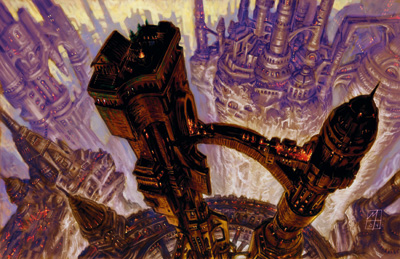
The Marxist sandbox has to be a city - in fact, it has to be the City. The traditional sandbox might be a border region perched on the edge of a monster-filled wilderness, but Marxist fantasy simply doesn't happen without industrial smokestacks belching forth noxious gasses in a city heaving with oppression, and the PCs can't be oppressed if they can simple escape the oppressor's power by leaving the city. It is a place like Sigil, or Sharn, or MoBu City - a city that's a world within itself. It should sprawl over many varied districts, each with their own unique character, some impoverished and ruined, others decadent and corrupt. Mapping the city probably defies logic and the ability of the game master, but Chris Kutalik might help. You might want to write a random generator for neighbourhoods, or steal an existing city and turn it in upon itself, using the perspective of a bottom-rung anarchist.
James Maliszewski talks about the importance of locales to the old-school method of play with his usual eloquence here; sandbox games don't run on pre-written plots. They need baroque locales for adventures to plunder and depths for adventurers to plumb. In a traditional sandbox, these are ancient tombs, lost temples, and haunted caverns. Our Marxist sandbox will instead be populated with mansions of venal judges and captains of industry, hellish factories, opulent banks, guard barracks, and corrupt temples. You can even have dungeons and caverns beneath the City, populated by the local powers of the underworld. Each locale should be ruled by some element of the oppressive hierarchy, the monstrous rulers of our anarchists' nightmarish world. In a twist on the traditional idea of the monster's lair, the various elements of a specific reactionary power's base may not all be located in one area. A bank may have branches across town, the town guards are certain to have many watch-houses, and an underworld figure may own several establishments across the City. You should treat these in some way as being part of the same adventure locale; if the players want to destroy the bankers' power, they may have to hit several different branches, or perhaps they just have to kidnap the owner from his harem-palace in the High Tower and hold him to ransom.
Monsters & Antagonists
The antagonists of your Marxist sandbox will be the varied agents of oppression. Since this is a fantasy game, you should make them as monstrous as possible; the high priest isn't just corrupt, he's a vampire. The secret police might employ mind flayers to rip the secrets from captured revolutionaries, or the underworld mob boss could literally be an ogre. Generally speaking, you can divide up your antagonists into a few categories:
- Predators: those who feed on the suffering of the populace, either literally or metaphorically. Opiates and Enforcers serve their needs, if perhaps indirectly.
- Opiates: those who try to keep the populace ignorant of their suffering.
- Enforcers: those who keep the boot on the neck those who try to rise up above their assigned station.
- Destroyers: the dark side of your revolutionary protagonists, these are not oppressors but instead destructive forces who aim to break everything down, not just the agents of oppression.
The front structure of Dungeon World might be an inspiration here when it comes to designing your sandbox, but with an important difference: the villains of the City are, with the exception of the destroyers, concerned with the maintenance of the status quo, not its downfall. In fact, this idea is what makes the City such an excellent sandbox for old-school gaming - the status quo mirrors the initial situation of a wilderness sandbox, infested with monsters and hostile to human life. Without the character's intervention, the machinery of oppression will simply continue to grind away, a boot stamping on the face of humanity forever.
Note: this post has been edited to remove references to a litigious individual
[To Coin a World] Pyresburg
The Beacon City
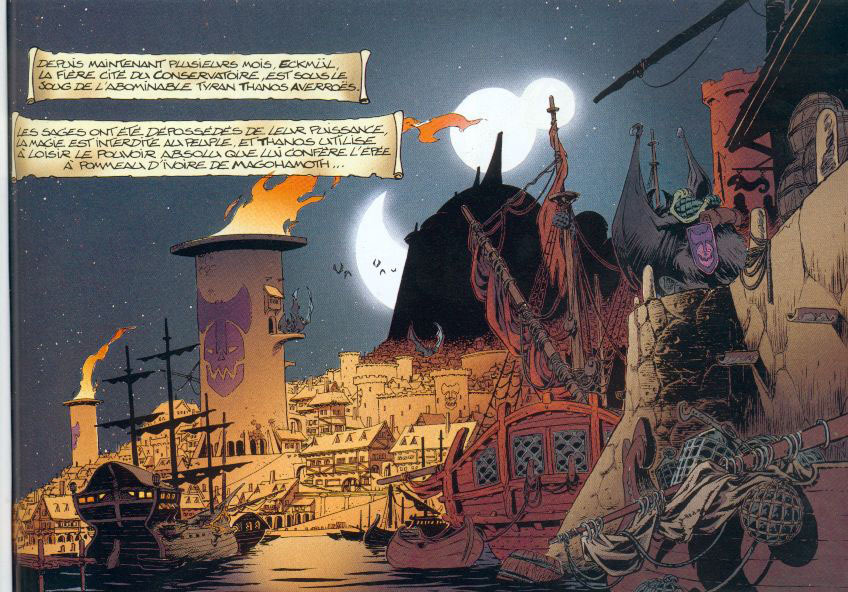 |
| A rather confused artist's impression of the city |
Pyresburg has stood (mostly) for nearly two thousand years (again, mostly. Damned wizards), andhas played a pivotal role in the building of a dozen empires. It is also home to a lot of pigeons. Some of whom are said to have interbred with vultures.
Theme and Mood
Theme: Light and Fire, Smoke and Shadow
Pyresburg has always been a beacon of civilization on Spindlewick, a shining example of everything a great city can be, what the fires of progress can forge. But it is also an example of every shadow that a beacon casts, and of what can be lost if a forge burns untended.
Mood: Bustling and Self-Absorbed.
The streets of Pyresburg are crowded and noisy at all hours of the day and night, thronging with locals, and visitors from all over the Coin. Most of these visitors are merchants, passing through, or selling to other merchants, as the city produces very little raw material itself. And yet somehow, even with this reliance on trade, those within its walls care little for the goings on outside, except as the occasional fashion or fad. The city has been here, always busy, always leading and lighting the way, for what seems like forever, while the rest of the world changes and follows.
The Sights
The Pyre
An incredibly tall solid (if slightly twisty) stone tower topped with a great fire, the Pyre for which the city is named has stood on its small rocky spit, serving as a lighthouse for as long as recorded history. In times of danger it is also used as a signal to the surrounding countryside by the simple expedient of adding an alchemical agent to change the colour of the flame, and on a clear night with some elevation and a spyglass, can be seen half-way across the world.
The Pyresbaron’s Palace
Supposedly the same building from which pyresburg has been ruled for the last two millennia, the Palace has been upgraded, downgraded, sidegraded, repainted, reoriented, reverted, inverted, added on to, or in some other manner modified by nearly every Baron to take residence in it (several of whom were quite crazy). As a result it is a rambling hodge-podge of architectural styles, stuffed full of rooms that nobody uses, or for even remembers the original purpose of.
 |
| A quiet evening |
The Windings
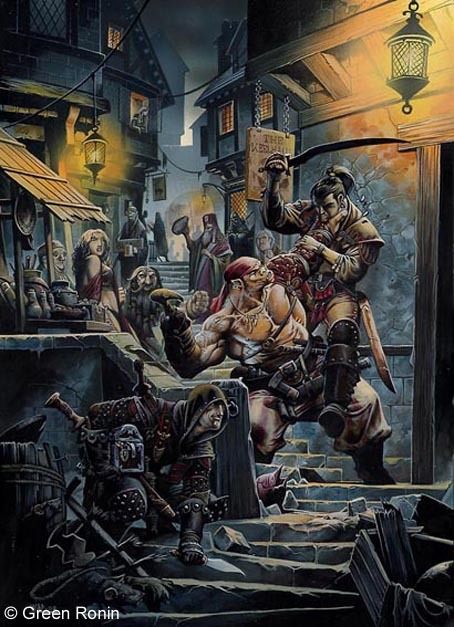
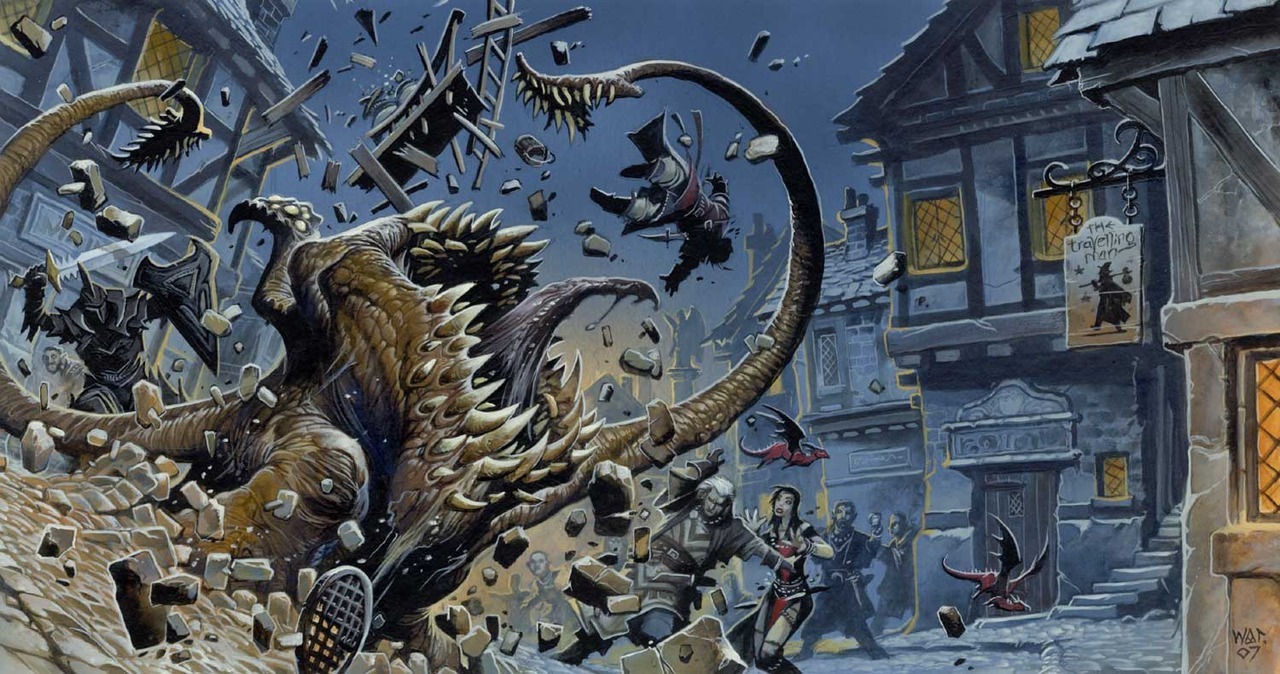
Even the most hardened warriors hesitate to enter this maze of twisty little alleyways, all alike. The majority of Hoblings in the city live here, alongside the dregs of human society, but do not be fooled into thinking that they’ve raised the property values. If anything, it has an even darker reputation than it did a hundred years ago when a mercenary giant wandered into the area and was found the next day, devoid of both his wallet and several internal organs.
The Night Market
Under the glare of the Pyre, the city never truly sleeps, and business of one sort or another continues at all hours. The night market fills several minor squares, the streets in between, and in some cases, even extending to the catacombs below, with vendors selling everything that you could find in a regular market (for the benefit of those who keep later hours), and a lot more strange or illegal things besides.
The Drowned Rat Tavern
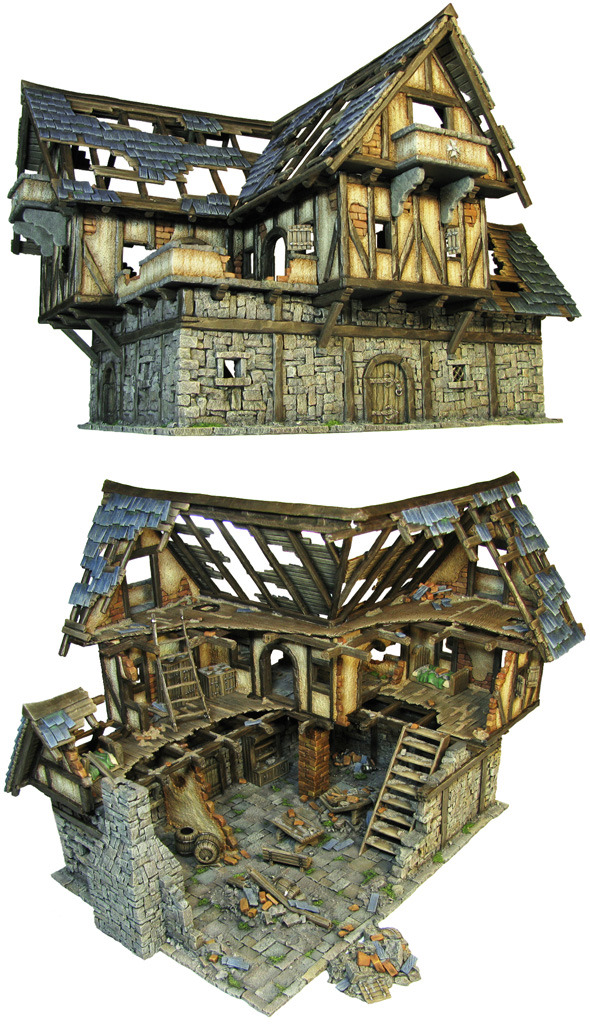
A famous drinking establishment, but sadly not for exemplary service or fine beverages. Rather, the Drowned Rat attracts daredevils and the terminally curious, as it has been destroyed seven times in the last ten years, always in unusual circumstances. Why the owner, Johann Vine, keeps rebuilding it, and how he gets the money to do so, is a mystery.
The Elvish Embassy
Maintained in unison by the Dawnwind elves of inland Spindlewick, and the seafarers of distant Yendys, the Embassy organises trade between the two elvish groups, as well as to the human nations nearby. It also provides food, lodging, and luxurious baths for elvish travellers, and an excellent location to look out over the teeming human city and feel suitably superior.
The Temple of Untold Gods
A natural out-growth of the city’s mercantile nature, ancient and varied history, and its siren song to all and sundry, the Temple of Untold Gods is technically run by priests of Omnia (Goddess of Everything Not Covered By Other Gods), but is in fact an omni-denominational church that rents out shrine space to new religions, and is often visited by those faithful to gods not widely known in the city. Behind the building proper is a small dump where the trappings of long-dead cults are deposited, occasionally sifted by the Academy’s theology department.
The Pyresburg Academy
 |
| Must be Tuesday... |
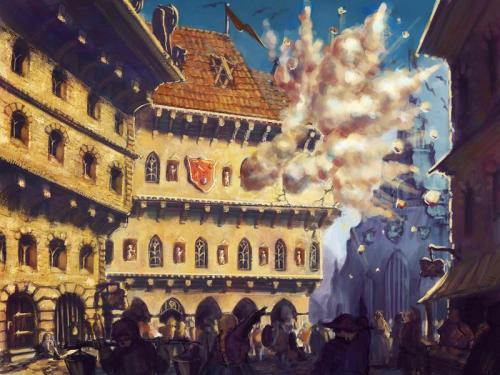
The oldest and most learned magical school on the Coin, the Academy was the greatest of its kind... until it burned down in mysterious circumstances 50 years ago, taking a fair chunk of the city, and all but a handful of wizards, with it. The rebuilding of the Academy has been an uphill battle, and it is still only a shadow of its former glory, but that very need to regain lost knowledge has made the Academy one of the best research institutes on Spindlewick, and a great place to sell rare books or magical devices. The locals have learned to largely ignore the periodic explosions and weird smells coming from the place.
Beneath the City
Pyresburg has existed for a long time, and the ground beneath it has taken on a consistency not unlike a Sbörk cheese – full of strange-smelling holes. Dwarf squats, Hobling warrens, basements, cellars, sewer systems both modern and long abandoned, underground sections of the old Academy (which are occasionally mobile), and older and more mysterious ruins jumble together beneath the streets. Some people tell tales of albino crocodiles that roam the underground. Those in the know scoff at such suggestions - crocodiles would be an easy meal for some of the things down there.
 |
| Yep, definitely Tuesday. |
Personages of Note
PyresBaron Tiberius Hacken
A
man bristly of moustache and large of ego, he considers himself a political
genius, and a great patron of the arts. Most people in the know consider him a
massively oblivious twit. How he’s survived nearly eight years since his
election, where his predecessors died of Chronic Enemies within months is anybody’s
guess.
Leonardor Doomwinch
Leonardor might well be the best dwarven engineer on the Coin, were he ever to actually finish constructing any of his inventions. Where most dwarves take pride in making a flawless finished work, Leonardor will only work on a project long enough to prove that he could hypothetically construct a perfect working construct. Of course, his designs are still incredible (if incomplete and occasionally hard to decipher), and even the basic prototypes for his inventions are marvels of engineering (if wildly unreliable), so he does not lack for patrons. There is a small industry of craftsmen in the city whose only job is to try to finish his designs, with varying success.
Daywatch Commander Lyadu Mzeze
A wandering
hunter-adventurer from Zwuyala, Commander Mzeze came to Pyresburg in pursuit of
a thief who had stolen a great trophy, the skull of a Zwuyalan Dire Tigerbear.
Her pursuit of this criminal accidentally uncovered a smuggling ring, and
caught the attention of the city watch. Intrigued by the prospect of hunting
criminals through the streets of Pyresburg, she joined up as a constable, and
30 years later she is commander of the entire organization. Off duty she is a
good humoured but sly old woman. On the job she is steely-eyed and tireless in
her pursuit of justice.
Nightwatch Captain Thragg Turnskull.
Mzeze’s
second-in-command, and Captain of the night shift, Thragg’s half-orcish
night-vision and muscular bulk serve him well defending the streets from
criminals. He shares his commander’s devotion to the Law, and to the City as a
whole, even if most people would rather have nothing to do with somebody of
orcish heritage.
Gonzo Loudfeet, Invasive Journalist.
Pyresburg
is home to many thieves and spies and blackmailers. And recently, it has become
home to something many consider even worse: a journalist. This obnoxious
chain-smoking, coffee-skulling Hobling doesn’t even have the good grace to sell
the information he purloins to the highest bidder, instead publishing it for
all the world to see (or at least all the world with a spare copper or two, and
the ability to read) in the daily broadsheet The Pyresburg Beacon.
Samuel
Pander, Senior Firefighter Patrol.
Pyresburg has been burnt to the ground a number of times over its sordid history, but it won't do so again on Sam's watch. Or so he says, at least. He may have his work cut out for him, as he's actually the ONLY member of the firefighter patrol, and has been for many years. But he continues to patrol the city, selling water to thirsty folk to make ends meet, as well as sharing the surprisingly accurate and hard to come by information he picks up on his rounds... for a price.
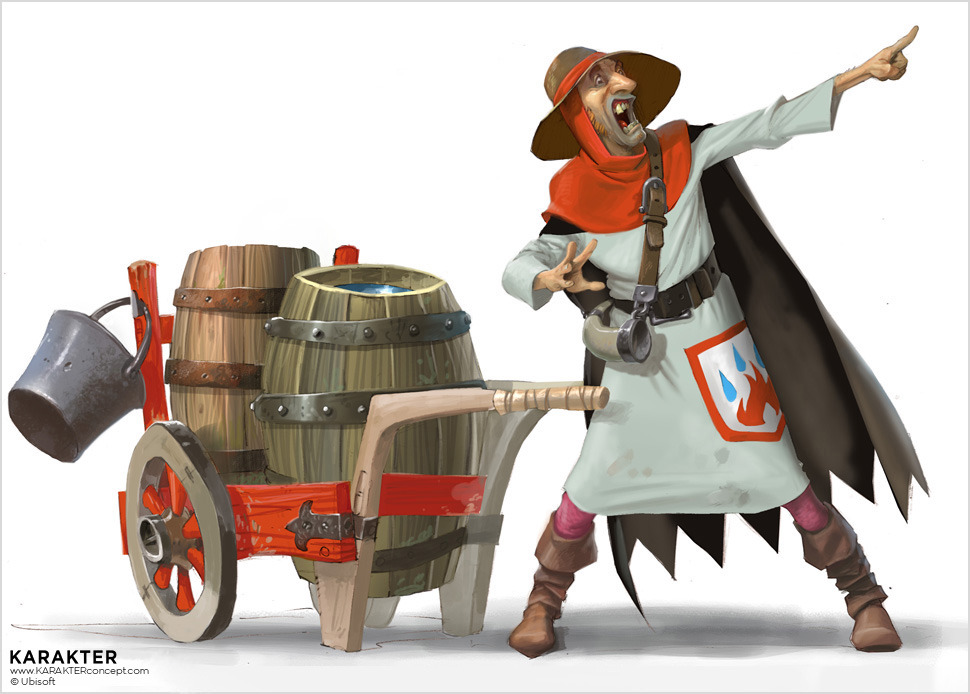 |
| Sam on a typical day. |
Criminal Groups
The Guild of Red Masks
The most famous guild of “gentleman” thieves and burglars on the Coin, the Red Masks’ official headquarters is in Pyresburg, according to legend, at least. Its membership are skilled, mobile, and universally possessed of a great deal of class, stealing only the most famous of objects, and looking down at the thugs and killers that are so common among the criminal class. The only way to enter the Guild is by invitation, and the only way to get that is with a heist executed with extreme daring, cunning and flair.
The Studded Brotherhood
At the other end of the spectrum of criminal activity is the Studded Brotherhood, named after their near-uniform of studded leather armour and helmets. This organization of thugs and assassins control crime in a fair portion of the city, and would probably control a lot more if their lack of finesse hadn't caused the Red Masks to subtly side against them.
Fighting Organizations
Have been covered elsewhere...
Random Encounters (d12)
- Puzzled tourist from some far off land, probably about to be fleeced.
- Studded Brotherhood gang-members loitering around.
- Wannabe Red Mask running from the Watch. Is aiming more for dashing rather than fleeing.
- The Pyresbaron's bright red coach, surrounded by guards.
- Sound of a distant explosion. Anybody nearby will mutter "bloody wizards".
- Watch patrol, seemingly loaded for bear. Will be puzzled if asked why they're heavily armed, as this is standard equipment.
- Beggars. Almost certainly collecting information for somebody.
- Sam Pander and his water-cart.
- Gonzo Loudfeet nosing about.
- Weird noises from nearby drain.
- See That Random Harlot Sub-table
- Fight. 50% chance scheduled bar-fight, 50% chance flashy sword-duel.
Wednesday, 15 February 2012
[Honor + Intrigue] Demi-Human Fighting Styles
Warhammer: 1d6 damage, +1 Beat, -1 Parry.
Elvish Sword-Spear: 1d6+1 damage, two-handed but without the Parry penalty usually associated with that
Elvish Sword-Spear: 1d6+1 damage, two-handed but without the Parry penalty usually associated with that
Friday, 3 February 2012
Nifflas
Factions of the Day (sigilesque)
- Librarians
- Inebriates
-
Airplanes
Televisions and radios
Junkforged
Currencies - money changing mechanic
- Librarians
- Inebriates
-
Airplanes
Televisions and radios
Junkforged
Currencies - money changing mechanic
- Skywhale teeth
- Miniature gewgaws
- Sunlight phials
- Corpse fingers
- Typewriter keys
- Thrupenny
Tuesday, 31 January 2012
En-Ru-Ob-Lem
City of the Drow
The Demonweb Pit
The
EDIT FROM JARRAH: not to be confused with M'HAHAHAHAHA, the dark elf city named after the distinctive call of the Yondan Mustache-Twirling Cookaburra. (Please feel free to delete this)
The Demonweb Pit
The
EDIT FROM JARRAH: not to be confused with M'HAHAHAHAHA, the dark elf city named after the distinctive call of the Yondan Mustache-Twirling Cookaburra. (Please feel free to delete this)
Sunday, 29 January 2012
Into the Far West
Damn, the Far West map has to be one of the most inspirational pieces of fantasy cartography I've seen. Just looking at that vista makes me want to pull on my kung-fu cowboy boots and ride off into the sunset.
They ran a Kickstarter earlier this year to release the roleplaying game, but I wasn't able to contribute as Amazon Payments isn't easily available to me as an Australian without a credit card. I wish that either Kickstarter would start supporting PayPal, or more RPG businesses would switch to using IndieGoGo (and other PayPal supporting websites) for their crowdfunding needs.
They ran a Kickstarter earlier this year to release the roleplaying game, but I wasn't able to contribute as Amazon Payments isn't easily available to me as an Australian without a credit card. I wish that either Kickstarter would start supporting PayPal, or more RPG businesses would switch to using IndieGoGo (and other PayPal supporting websites) for their crowdfunding needs.
[To Coin a World] The Dwarven Agricultural Revolution
-200 years: dwarves subsist primarily on fungal products, poor mountain-side farming, and trade with human farmers
-150 years: clever dwarven runesmith inscribes rune for sun on seeds of barley plant, leading to plants that can grow out of the sun
-100 years: sun-free barley farming becomes reasonably common in the dwarven mountain holds. surface farming communities are abandoned (ruins!), holds become more crowded as the dwarven population grows
-50 years: growing population pressures spark massive social discontent among suddenly large population of young dwarves, leading to internecine clan feuds and gross migration out of dwarven communities and into human cities
-50 years to present: human and dwarven communities become more tightly integrated thanks to migration. dwarven holds develop new mines and mining techniques that vastly increase the supply of metals across Spindewick. pri
-150 years: clever dwarven runesmith inscribes rune for sun on seeds of barley plant, leading to plants that can grow out of the sun
-100 years: sun-free barley farming becomes reasonably common in the dwarven mountain holds. surface farming communities are abandoned (ruins!), holds become more crowded as the dwarven population grows
-50 years: growing population pressures spark massive social discontent among suddenly large population of young dwarves, leading to internecine clan feuds and gross migration out of dwarven communities and into human cities
-50 years to present: human and dwarven communities become more tightly integrated thanks to migration. dwarven holds develop new mines and mining techniques that vastly increase the supply of metals across Spindewick. pri
Lawful What? An Alternative Alignment System

I have always been vaguely fascinated with the alignment system in Dungeons & Dragons; somehow, its unsatisfactory codification of ethical complexities into a simple nine-point grid holds a certain charm. You know what your Lawful Good paladin stands for, and why he has issues with the Chaotic Good bard, even though they're both on the side of the angels. The merits of the scheme are probably best expressed in Planescape, where it forms an expressive backdrop for the Great Wheel's unique cosmology and the interplay of belief and ideas.
In that vein of thought, let me present a somewhat whimsical alternative to the standard system of ethical and moral alignment, in which character's personal values and codes are presented in the form of Colours, Pieces, and Suits. It could be easily used in place of any system of codifying characters' moral or ethical alignments. A honour-bound steel-hearted paladin might be a White Knight of Diamonds, while passionately faithful paladin might be a Red Bishop of Hearts.
Colours
The Colour of one's character represents their moral perspective on the world. In a phrase, you might say it colours their definition of good and evil.
White
The colour White stands for strict benevolence, for the greater good over all other concerns and emotions. To be aligned with White is to reject the concerns of the self and focus only on the betterment of the world. White is the most moral of all the Colours because it rejects selfishness and destructive emotions.
Red
Passion and romantic idealism are embodied by Red. Red characters are lovers and warriors, fighting boldly for their ideals even in the face of reason. Red is the most moral of all the Colours because it holds love to be the most important force in the universe.
Grey
Grey is a rejection of extremes. The Greys stand for balance between competing forces; a neutral stance in a complex universe that cannot truly be understood. Grey is the most moral of all the Colours because it rejects extremes and holds to neutrality.
Yellow
In the spectrum of Colours, Yellow represents greed and self-interest, but also ambition and the seizing of opportunities. Yellow characters can be greedy mercenaries or gluttonous merchants, but they can also be ambitious artists who hold their work above all. Yellow is the most moral of all the colours because one can only be true to one's self.
Black
Black is the colour of the void and of oblivion. It is the colour of nihilists who hold that the universe is flawed and the destruction, and deserves to be corrupted or destroyed. They may not take any pleasure in suffering or destruction, but Black characters fundamentally believe in the wrongness of creation. Black is the most moral of colours because the universe deserves to be destroyed.
Pieces
Pieces refer to the relationship with power and authority; how one reacts to rules and laws, and where one believes ultimate responsibility lies.
Bishop
A Bishop places their faith solidly in the otherworldly and the divine. They hold that moral order stems from some force greater than themselves, rather than from any human ideals. Morality may come in the form of a divine text, or in the answers they hear in their personal prayers, but it is something unmistakably unworldly and immaterial.
Knight
Knights hold true to a personal code of honour and conduct, unalterable by external forces.
Rook
To be a Rook is to respect temporal authority and to hold true to one's station in society. They hold laws and traditions in high regard, and will not easily be moved to break them. Rooks make implacable servants and loyal officers, and can often be found serving in bureaucracies, or as guardians of civic order and virtue.
Jack
"No lords, no masters!" is the dying creed of the Jack. Mercurial and changeable, they cannot be pinned down to any code of conduct. Jacks are anarchists and radicals, scoundrels and renegades; found only on the edges of a society they fundamentally reject.
Queen
Some believe that authority stems fundamentally from themselves. These Queens are the ambitious and the powerful, those who believe themselves the rightful makers of law. While they may hold to some moral code, they believe themselves best placed to implement it in society.
Suits
A character's Suit represents the virtues that they value most strongly, and the means by which they seek to achieve their goals.
Diamonds
Diamonds respect excellence in all areas of life, and disdain the mediocre. No Diamond will settle for good enough; they will always push to achieve greater heights of skill or quality. The greatest gift you can give a Diamond is an exquisitely crafted tool or weapon.
Hearts
A character in the suit of Hearts will hold creativity as the greatest of virtues. To create is to be close to the divine spark, to touch the gods. They strive for innovation, beauty, and clever solutions to difficult problems. The greatest gift you can give a Heart is an expressive work of art.
Spades
Spades value diligence and simplicity; the virtue of a hard day's work. The greatest gift you can give a Spade is to satisfy simple pleasures with a hearty meal and a refreshing beverage.
Clubs
Clubs thrive on competition and in contests of skill. They seek to prove themselves superior through victory over their foes and rivals. The greatest gift you can give a Club is to challenge them to a game that tests their strengths against yours.
Jokers
The unpredictable and the unexpected are the domain of the Joker. Nothing is sacred; they push for change at every opportunity. The greatest gift you can give a Joker is something unique and surprising.
The Librarian
Moves:
Library Card: When you go into the library searching for information, roll +Librarian. On a 10+, you easily find a book on the topic on one of the Lower Shelves. On a 7-9, choose 1 of the follow:
Moves:
Library Card: When you go into the library searching for information, roll +Librarian. On a 10+, you easily find a book on the topic on one of the Lower Shelves. On a 7-9, choose 1 of the follow:
- You find the book in the catalogue, but it's on one of the Upper Shelves.
- You find a book that's not quite right.
- You don't find the book, but you do find stories worth 1-name.
On a miss, you find the book and it's Forbidden.
Wednesday, 18 January 2012
The World is a Savvyhead's Workspace
Gregor Vuga's thoughts on how exploration-based advancement could work are definitely close to what I'd like to see from a sandbox game.
Subscribe to:
Posts (Atom)