Showing posts with label design. Show all posts

Wednesday, 27 June 2012

Marx & Monsters: A Radical Leftist Fantasy Sandbox

Credit: anndr on deviantart
China Mieville's New Crobuzon novels portray a corrupt city where the forces in power are utterly morally bankrupt. In stark contrast to the cliche-ridden rut of modern fantasy literature, no shining knights or noble lords infest the universe of Mieville's fecund imagination. His characters are drawn from the radical bohemian crowd that thrives in the interstices of this city - anarchist journalists, labour organisers, avante-garde artists, and disgraced scientists. It's no surprise when you consider the author's political leanings - he's a dyed-in-the-wool Marxist with a PhD in International Law who actually ran for Parliament as a Socialist in 2001. In this context, power structures are examined from the perspective of the downtrodden and the oppressed - and found deeply wanting. Rather than holding the status quo as some natural state of goodness, a crippling stasis is held in place by the forceful action of the corrupt and powerful.

Narratives that build from this perspective tend to resonate with our inner sympathetic selves. It's no coincidence that most great adventure stories are told from the perspective of the underdog - the Rebel Alliance against the Empire, Indiana Jones against the entire Nazi Reich, and so on. Upstanding moral heroes who act to preserve the status quo make no sense in the sandbox-style gaming so beloved by the OSR, which is why dungeons tend to be filled by roguish heroes and wandering murder-hobos. Preserving the status quo is an inherently reactionary position to take up, and that's why Superman makes no sense as a hero in a sandbox - he needs an active threat, a pre-meditated plot to respond to before his narrative actually takes place.

In contrast, making the heroes of your game revolutionaries fighting against a capitalistic status quo makes perfect sense from a sandbox perspective, and from an anarchist perspective where all power is inherently suspect, your freedom fighters are the upstanding moral heroes. When you compare the problem faced by the radicals with the problem faced by your traditional sandbox rogue, the inherent similarity of the narrative becomes obvious:

     The Rogue
  1. The world is filled with horrible monsters.
  2. We can't possibly kill all the monsters. 
  3. But if we kill enough, we might save some people and get stinking rich from treasure.
     The Radical
  1. The world is ruled by the corrupt and powerful.
  2. We can't possibly destroy all of the corrupt power structures.
  3. But if we destroy enough, we might lessen the burden of the proletariat or inspire a broader revolution.
Basically, you are building a game where the terrorists are the good guys. So what do you need to build a sandbox for a motley bunch of Marxist revolutionaries?


Characters & The Party

Characters should be drawn from the anarchists, the downtrodden, labour organisers, bohemians, radicals - those who have an interest in overthrowing the established power structures. In keeping with the tradition of sandbox adventurers, you don't want to create too much background for the characters, but they need to have a rationale for opposing the entrenched hierarchy. A random generator for motivations and radical affiliations is probably all you need; they can still be fighters, wizards, and rogues, but they're fighters, wizards, and rogues from outside the system's social consensus. If you have all the characters start off as members of some revolutionary cell or outlawed organisation, you've got all the motivation you need for the "adventurers" to start robbing some banks.

Experience Points & Rewards

There are a tonne of articles around the blogosphere explaining why the old-school "treasure for XP" mode of play helps deliver the ideal sandbox experience for roguish adventures. In short, the idea is that "treasure for XP" rewards inventive play in a way that "quest XP" or "monster XP" simply doesn't - you have no incentive to face that monster other than its treasure, and if you can steal or capture the treasure through other means beyond direct confrontation, you're just as well off.

This is the sort of play we want to encourage in our revolutionary PCs, but "treasure for XP" might not create the right kind of incentive. Our mystical Marxists aren't adventuring to gather wealth and become part of the establishment - they're here to bring down The Man, and liberate the proletariat from oppression. We're looking for something that encourages inventive play towards the destruction of capitalist power, not accumulation of it.

Option number one is simply to rephrase the idea of "treasure for XP". Instead of gaining XP per unit of wealth acquired, you could award XP per unit of capitalist wealth destroyed or redistributed to the oppressed classes. It's a reasonably simple method that might work if you want to keep the granularity of old-school experience systems.

A second option would be something similar to the experience model of Dungeon World, where experience is awarded based on a series of end-of-session questions answered by the party. All you have to do here is change the questions to something more appropriate for our anarchistic adventures. Instead of the questions:
  • Did we learn something new and important about the world?
  • Did we overcome a notable monster or enemy?
  • Did we loot a memorable treasure?
and marking experience for each "Yes" answers, you might ask:
  • Did we learn something new and important about the City?
  • Did we overcome a notable source of oppression?
  • Did we lessen the burden of the proletariat? 
and award experience on that basis.

Setting & Locales
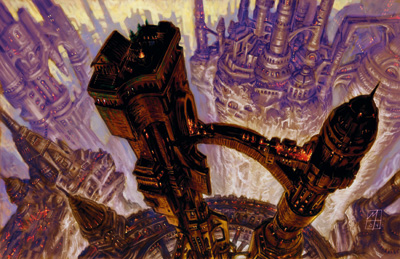
The Marxist sandbox has to be a city - in fact, it has to be the City. The traditional sandbox might be a border region perched on the edge of a monster-filled wilderness, but Marxist fantasy simply doesn't happen without industrial smokestacks belching forth noxious gasses in a city heaving with oppression, and the PCs can't be oppressed if they can simple escape the oppressor's power by leaving the city. It is a place like Sigil, or Sharn, or MoBu City - a city that's a world within itself. It should sprawl over many varied districts, each with their own unique character, some impoverished and ruined, others decadent and corrupt. Mapping the city probably defies logic and the ability of the game master, but Chris Kutalik might help. You might want to write a random generator for neighbourhoods, or steal an existing city and turn it in upon itself, using the perspective of a bottom-rung anarchist.

James Maliszewski talks about the importance of locales to the old-school method of play with his usual eloquence here; sandbox games don't run on pre-written plots. They need baroque locales for adventures to plunder and depths for adventurers to plumb. In a traditional sandbox, these are ancient tombs, lost temples, and haunted caverns. Our Marxist sandbox will instead be populated with mansions of venal judges and captains of industry, hellish factories, opulent banks, guard barracks, and corrupt temples. You can even have dungeons and caverns beneath the City, populated by the local powers of the underworld. Each locale should be ruled by some element of the oppressive hierarchy, the monstrous rulers of our anarchists' nightmarish world. In a twist on the traditional idea of the monster's lair, the various elements of a specific reactionary power's base may not all be located in one area. A bank may have branches across town, the town guards are certain to have many watch-houses, and an underworld figure may own several establishments across the City. You should treat these in some way as being part of the same adventure locale; if the players want to destroy the bankers' power, they may have to hit several different branches, or perhaps they just have to kidnap the owner from his harem-palace in the High Tower and hold him to ransom.

Monsters & Antagonists

The antagonists of your Marxist sandbox will be the varied agents of oppression. Since this is a fantasy game, you should make them as monstrous as possible; the high priest isn't just corrupt, he's a vampire. The secret police might employ mind flayers to rip the secrets from captured revolutionaries, or the underworld mob boss could literally be an ogre. Generally speaking, you can divide up your antagonists into a few categories:
  • Predators: those who feed on the suffering of the populace, either literally or metaphorically. Opiates and Enforcers serve their needs, if perhaps indirectly. 
  • Opiates: those who try to keep the populace ignorant of their suffering. 
  • Enforcers: those who keep the boot on the neck those who try to rise up above their assigned station.
  • Destroyers: the dark side of your revolutionary protagonists, these are not oppressors but instead destructive forces who aim to break everything down, not just the agents of oppression.
The front structure of Dungeon World might be an inspiration here when it comes to designing your sandbox, but with an important difference: the villains of the City are, with the exception of the destroyers, concerned with the maintenance of the status quo, not its downfall. In fact, this idea is what makes the City such an excellent sandbox for old-school gaming - the status quo mirrors the initial situation of a wilderness sandbox, infested with monsters and hostile to human life. Without the character's intervention, the machinery of oppression will simply continue to grind away, a boot stamping on the face of humanity forever. 

Note: this post has been edited to remove references to a litigious individual

Sunday, 29 January 2012

Lawful What? An Alternative Alignment System


I have always been vaguely fascinated with the alignment system in Dungeons & Dragons; somehow, its unsatisfactory codification of ethical complexities into a simple nine-point grid holds a certain charm. You know what your Lawful Good paladin stands for, and why he has issues with the Chaotic Good bard, even though they're both on the side of the angels. The merits of the scheme are probably best expressed in Planescape, where it forms an expressive backdrop for the Great Wheel's unique cosmology and the interplay of belief and ideas.

In that vein of thought, let me present a somewhat whimsical alternative to the standard system of ethical and moral alignment, in which character's personal values and codes are presented in the form of Colours, Pieces, and Suits. It could be easily used in place of any system of codifying characters' moral or ethical alignments. A honour-bound steel-hearted paladin might be a White Knight of Diamonds, while passionately faithful paladin might be a Red Bishop of Hearts.

Colours
The Colour of one's character represents their moral perspective on the world. In a phrase, you might say it colours their definition of good and evil.

White
The colour White stands for strict benevolence, for the greater good over all other concerns and emotions. To be aligned with White is to reject the concerns of the self and focus only on the betterment of the world. White is the most moral of all the Colours because it rejects selfishness and destructive emotions.

Red
Passion and romantic idealism are embodied by Red. Red characters are lovers and warriors, fighting boldly for their ideals even in the face of reason. Red is the most moral of all the Colours because it holds love to be the most important force in the universe.

Grey
Grey is a rejection of extremes. The Greys stand for balance between competing forces; a neutral stance in a complex universe that cannot truly be understood. Grey is the most moral of all the Colours because it rejects extremes and holds to neutrality.

Yellow
In the spectrum of Colours, Yellow represents greed and self-interest, but also ambition and the seizing of opportunities. Yellow characters can be greedy mercenaries or gluttonous merchants, but they can also be ambitious artists who hold their work above all. Yellow is the most moral of all the colours because one can only be true to one's self.

Black 
Black is the colour of the void and of oblivion. It is the colour of nihilists who hold that the universe is flawed and the destruction, and deserves to be corrupted or destroyed. They may not take any pleasure in suffering or destruction, but Black characters fundamentally believe in the wrongness of creation. Black is the most moral of colours because the universe deserves to be destroyed.

Pieces
Pieces refer to the relationship with power and authority; how one reacts to rules and laws, and where one believes ultimate responsibility lies.

Bishop
A Bishop places their faith solidly in the otherworldly and the divine. They hold that moral order stems from some force greater than themselves, rather than from any human ideals. Morality may come in the form of a divine text, or in the answers they hear in their personal prayers, but it is something unmistakably unworldly and immaterial.

Knight
Knights hold true to a personal code of honour and conduct, unalterable by external forces.

Rook 
To be a Rook is to respect temporal authority and to hold true to one's station in society. They hold laws and traditions in high regard, and will not easily be moved to break them. Rooks make implacable servants and loyal officers, and can often be found serving in bureaucracies, or as guardians of civic order and virtue.

Jack
"No lords, no masters!" is the dying creed of the Jack. Mercurial and changeable, they cannot be pinned down to any code of conduct. Jacks are anarchists and radicals, scoundrels and renegades; found only on the edges of a society they fundamentally reject.

Queen
Some believe that authority stems fundamentally from themselves. These Queens are the ambitious and the powerful, those who believe themselves the rightful makers of law. While they may hold to some moral code, they believe themselves best placed to implement it in society.

Suits
A character's Suit represents the virtues that they value most strongly, and the means by which they seek to achieve their goals.

Diamonds
Diamonds respect excellence in all areas of life, and disdain the mediocre. No Diamond will settle for good enough; they will always push to achieve greater heights of skill or quality. The greatest gift you can give a Diamond is an exquisitely crafted tool or weapon.

Hearts
A character in the suit of Hearts will hold creativity as the greatest of virtues. To create is to be close to the divine spark, to touch the gods. They strive for innovation, beauty, and clever solutions to difficult problems. The greatest gift you can give a Heart is an expressive work of art.

Spades
Spades value diligence and simplicity; the virtue of a hard day's work. The greatest gift you can give a Spade is to satisfy simple pleasures with a hearty meal and a refreshing beverage.

Clubs
Clubs thrive on competition and in contests of skill. They seek to prove themselves superior through victory over their foes and rivals. The greatest gift you can give a Club is to challenge them to a game that tests their strengths against yours.

Jokers
The unpredictable and the unexpected are the domain of the Joker. Nothing is sacred; they push for change at every opportunity. The greatest gift you can give a Joker is something unique and surprising.

Tuesday, 18 October 2011

A thought about local linguistics

Recently I've been studying the Late Middle Ages/Renaissance, in particular in Italy. It's become increasingly apparent that 1: it's a great time and place for gaming, and 2: I already knew that, sort of, because how I've always imagined Pyresburg and various other bits of the coastal area near the Friendly Sea sort of matches up with what I'm learning.

Except for the names. The few locations I've actually given names that my players are aware of (the few-ness being a problem I need to fix...) sound like what they are: compound words, or purely made-up stuff. In both cases, chosen by somebody who can only speak English, and horrifically anglicizes any foreign words he comes across. What they don't sound like is Italian.

But maybe there's a (hastily ass-pulled) reason for this: they're "translated" to make them sound like they originated in the player's native tongue, much like in the game-world they originated in the character's native tongue and don't sound like they're "foreign".

Would you buy this explanation as a player? Have you used similar explanations before? Have I adequately explained my thoughts?

Monday, 9 August 2010

[Exalted] Municipal Charms

A range of Charms for the discerning Alchemical city-being, some collected from around the internet and some created by myself.

Avatar-Launching Silo
Contained within great steel and brass tubes, the Avatar-Launching Silos prepare and spin out facsimiles of the metropolis' ancient human-scale body. The avatars hold much of the power of the metropolis, but they are not drone-like creations nor mere limbs of the great metropolis. Each avatar has its own personality, its own identity, forged from a shard of the metropolis' expansive consciousness.

Champion Heart Efficiency Matrix: These submodules refine and expand the starmetal essence reservoirs within each avatar.
Titan Shard Reservoir: This submodule adds an enormous jade sarcophagus, stored in the depths of the Avatar-Launching Silo. Within this immense submodule rests a colossus-sized avatar of the metropolis.
Rapid Drone Operations System: Each avatar's sacrophagi is retrofitted with a jade-alloy casing, filled with safety webbing and Essence-injecting conduits. The silo itself is retrofitted with steam catapults and moonsilver rails that allow the launching of sarcophagi at distant locales at short notice. On impact, the sarcophagi shatters open to reveal the avatar within, showering all those surrounding with jade shrapnel.
Apogee-Shattering Hammer Deployment: This submodule replicates the effect of Rapid Drone Operations System for the Titan Shard Reservoir, allowing the immense colossi to be launched through the air and impact onto hostile positions.

Integrated Observation Network
With this charm, the patropolis is outfitted with sensor-posts linked by a network of glistening silver cables, extending throughout the city. At a moment's notice, any sensor-post can be reflexively activated by the patropolis' governing Alchemical, extending their awareness and allowing them to perceive all that transpires in the area. The system does not grant the patropolis omniscience, as the number of sensor-posts that can be activated is strictly limited by the Alchemical's ability to focus, and individual nodes are still vulnerable to attack and destruction.

Motile Surveillance Platforms: With this submodule installed, the individual sensor-posts become flittering mobile platforms the size of a small bird. They still cannot move beyond the city limits.
Visual Remembrance Matrix: Crystalline memory devices are installed into each sensor-post, allowing the visual memory of any post in the city to be downloaded into the Alchemical's memory. Auditory records cannot be stored within the crystals, and thus sound is absent from these recordings.
Discreet Vigilance Design: The sensor-posts are integrated into the patropolis' architecture in a way that makes them invisible to the casual observer, even while in use.
Sapient Scrutiny Spirit: A simple artificial spirit is downloaded into the observation network. It can be pre-programmed to alert the Alchemical guiding mind of any particular suspicious activity, bringing their awareness to that particular node.

Oneirological Monitoring System
Prerequisites: Integrated Observation Network
Unique moonsilver pentagrams are installed in the sleeping quarters of the city. Shadowy shards of the patropolis' consciousness are dispatched into the dreamscapes of the populat allowing them to monitor for dissent and other unhealthy impulses.

Cloud-of-Dreams Cortex
On installing this Charm, the metropolis extends sensitive starmetal antennae throughout her body. When activated, it draws on the unused processing power of the unconscious citizenry, improving the Alchemical's ability to conduct calculations and projections.

Catatonic Calculus Cognitor: When this submodule is installed, themettropolis gains the ability to directly seize control of the conscious minds of the city, temporarily turning them into catatonic outgrowths of her cognition systems. This act vastly increases the computational power of the patropolis, but at a terrible cost.

Shadow Government Dream
Prerequisites: Oneirological Monitoring System, Cloud-of-Dreams Cortex
Using complex metaphysical symbology and oneirological protocols, the central core and governing body of the patropolis are removed bodily from the realm of existence. Instead, it lives in a dream world held within the minds of populace, issuing orders and planning operations from a position of unparalleled security. This charm does not guarantee the compliance of the Populat, but it provides immunity for the government and the patropolis' core from most forms of physical and societal attack.

Subconscious Punishment Methodology: This submodule allows for punishments to be directed at members of the populat during their sleep, inflicting terrible tortures and nightmares on the maladjusted and the criminal.
Nocturnal Propaganda Inception: This submodule allows the patropolis to adjust the dreams of the populat, showing visions of industrial heroism and tales of nationalistic pride. It subtly adjusts mindsets, creating a populat more devoted to the patropolis and more vigorous in their labours.
Dreams-Within-Dreams Architecture: For the truly paranoid patropolis, this submodule constructs a secondary dreamscape within the first to house the Shadow Government Dream, placing it at even further remove from the physical world. This prevents foes with oneirological manipulation powers from easily penetrating the apparatus of the patropolis.

[Microlite20] The Alucard School of Serious Swordplay

Most fencing academies on the Coin focus on pure swordplay - that is, dueling against opponents armed themselves with swords. The École d'Alucard in Languille, in contrast, is a far less traditional school. Recognising the more complex dangers of the modern world, the École d'Alucard arms its students with the techniques and talents necessary to brandish their blades in battle against a wide range of opponents - axe-wielding orkish barbarians, duergar musketeers or even in the more advanced classes, tentacled monstrosities of death.

Fencing Feats for Fighters


Fencer's Fancy Footwork
Prerequisite: Nimble Sworsdman
When wielding a one-handed blade, you may move one square whenever an enemy misses an melee attack against you. (immediate action)

Unconventional Parrying Technique
Prerequisite: Fencer's Footwork
Once per turn, you may choose to parry any melee attack against you. Roll an attack roll. On a 15+, you parry the attack but may not make any attacks in the next turn. On a 21+, you parry the attack and can attack in the next turn.

Alucard's Anti-Archery Adaptation
Prerequisite: Unconventional Parrying Technique
You can use Unconventional Parry Technique against ranged non-magical attacks.

Tentacle Slashing Slayer
Prerequisite: Unconventional Parrying Technique
You can try to remove a creature's arms and tentacles as a standard attack. Roll an attack roll. On a 15+, you only slightly wound the creature, forcing it to recoil somewhat. It cannot use its limb next round. On a 21+, you severe the relevant limb and deal damage as normal.

Sunday, 27 September 2009

My Darn Ex-Wife

(distinctly inspired by this)

Space is big.

Duke County, Alabama, where the lot of you have spent the majority of your short Earth lives, is considerably smaller. However, y'all are about to see a hella lot more of the former. Y'all remember TJ's good-for-nothing ex, Linda-Lee? The chain-smoking one in the trailer park? Well, turns out her new beau, Greg, is actually Gregorix IV, Heir to the Radiant Throne of the Tauron Imperium. No shit. And she's decided that this gives her the right to take little Connor and Maddi-Sue off all by herself. In clear violation of the joint custody agreement, mind you.

Now, that just ain't right. And us all is going to do something about it.


My Darn Ex-Wife

I've been toying with the idea of a rednecks-in-space game based on the FTL Y'all concept for a long time. When I stumbled upon John Harper's magnificent Lady Blackbird, it didn't take me long to conclude that it would be a perfect rule-set for the sort of light, gonzo, character-driven action-adventure I had envisaged. It took me until this past weekend to actually act on the concept, when I was able to toss together a few friends and run a short game of My Darn Ex-Wife. The game was unfortunately cut short by time limitations, but we did manage to have a few enjoyable moments, starting from TJ and Auntie Mae searching Linda-Lee's trailer, and ending with Our Heroes departing for Quadrants Unknown in TJ's hastily hyper-converted pickup truck, with Squid Head Bill tied down in the back end.

The core structure of the game seemed to work well; the characters engaged with one another and drew life from their Traits and Keys. However, I feel like the initial opening situation needs to be more aggressive and have more bite. Lady Blackbird's opening situation pushes the characters to act, immediately. By contrast, after discovering the scorch marks on Linda-Lee's lawn, the posse spent a fair amount of time trying to call on legal aid, first from the police and then from the lawyers. Instead of framing the game at the start of the story, I need to find an exciting situation to toss the characters into immediately. I toyed with the idea of stealing Lady Blackbird's opening whole-heartedly, but it seemed too derivative. In any case, with their navigation-free warp jump at the end of the first session, I have plenty of rope to hang them with at the start of the next session.

It did turn out to be absolutely hilarious in play... for one, the hideously terrible southern accents put on by a group of Australian gamers made everyone's day, and Jarrah's portrayl of Squid Head Bill as a tentacled Bill Bailey was brilliant.

Comments, criticism, and open insults are welcome.

Tuesday, 21 July 2009

Rock the Underdark

The crowd is a shrieking, moaning, roaring mass of flesh and bone. It roils like an angry sea beneath the cavernous roof of the Pit, orcs jostling with gnolls for shoulder room, goblins climbing and scuttling everywhere. The troll bouncers make no attempt to control the crowd as it turns upon itself in anticipation. In the midst of the chaos, a single beam of light streams down, illuminating a circle on the stage.

A single dark elf steps out into the light, clutching an instrument that mixes a bass guitar with a dying baby. His hand is poised to strike.

A black, unearthly wail echoes out from the stage.

The crowd goes silent.

The band has begun to play.

Spark of Genius

I've been punting the idea of a game about a rock band since Guitar Hero first hit my living room. It's a simple formula - nearly everyone feels the desire to be a famous musician at some point in their life. Yet it never quite clicked for me, until I stumbled upon a children's book by Graeme Bass, The Worst Band In The Universe. Somewhere among the images of weird aliens wailing away on bizarre, impossible instruments I found the seed of an idea: monsters in a rock band.

And where better to find monsters than the Underdark?

The question is, where do I go from here?
I can't quite find a game that lets me tell the stories I want to tell in this world.
I want a game that emphasizes the way that the flaws of the characters drive the power of their music, and the difficult struggles within a band made up of orcs, elves, and ghouls. Traditional games are right out, and I can't quite find the indy game that hacks in the way I want it to. I may have to build one myself.