Showing posts with label generic fantasy. Show all posts

Wednesday, 18 July 2012

Burn the Dark Lord!

So, our heroes face a Dark Lord, an evil and vile sorcerer (usually. Why are so many bad guys magic users?)... Cool. A bit cliche, but cliche for a reason - evil and vile sorcerers are excellent villains to face. They've got class.

And by class, I mean a hat with horns on it. 

But say you're in a bit of a rush. Well, allow me to present a set of tables for creating a dastardly magic user quickly.

First, he or she needs a name - there are various random generators out there, but none I personally particularly like. I'm sure you can work out something. Maybe name him after a disease? I've always loved "Anthrax" as an evil name.

Now, assuming that your villain is a wizard (a pretty safe assumption), then they'll need spells. I heartily recommend Zak's method of quick spell selection (the battle oracle in the same post is kinda neat too, especially if the PCs consult an oracle before facing the dark lord).

What other dastardly tricks can the dark lord do? One of these, mostly likely. (WARNING, annoying use of bad punctuation and CAPS LOCK. Probably for irony purposes or something).

As an optional third step, what's stopping the PCs from just killing the dark lord? Roll a d20. First 12 results are off this table here, the remainder are below (subtract 12 from result). If you don't like any of these, just do your darndest to make sure they stay out of the PCs' combat reach until a suitably dramatic moment.
  1. Lich. Hey, it's a classic. Can't be killed unless you find the little box holding his soul. 
  2. Annoyingly complex lich - soul split into several bits, each stored in different objects in different places. Can only die when they've ALL been destroyed.
  3. Dead man switch - if the bad guy is killed, then something even worse gets to use his dead body as a portal to access the world.
  4. Soul-bound siblings - somebody the PCs like is actually the twin of this guy, and if one dies, so does the other. 
  5. Minor God - like Thor or Loki from the Avengers, not entirely immortal, but really damned tough. In D&D terms, probably has several times the HP of the entire party put together, and recovers very quickly.
  6. Baldur-dash - made deals with the spirits/gods of every inanimate material, bar one type of tree (Holly? Oak? Palm-trees?). Can only be hurt by weapons made out of that kind of tree. 
  7. I Think I'm a Clone Now - is actually one of several duplicate copies, all equally skilled. If you kill one, another will arise from the shadows to take over his schemes. 
  8. Was never born in the first place - how he exists in defiance of the laws of causality is a mystery, but he can't actually be killed until targeted with a reincarnate spell. 

So... what's the evil plot? Roll a d30, or pick.
Obviously, these are all cribbed from movies, books, or games, and still need some fleshing out. Try not to assuming that the PCs will do anything in particular, just make sure they're in the Villain's path.
  1. He has kidnapped the princess and transformed her into a swan (or other beast), and will only lift the curse if she agrees to marry him, giving him legitimate claim to the crown.
  2. Plans to sacrifice a prophetically-picked virgin on the night of the eclipse, after which he will be able to transform into a dragon. 
  3. Has captured the prince and replaced him with a polymorphed lacky. Now living the high-life at the grace of the strangely-acting "prince". Must regularly get blood samples from the prince to maintain the spell. 
  4. Has sent vile minions (orcs are traditional) to retrieve the artifact forged by an even greater and more evil sorcerer in the depths of time. If she gets it, it will greatly magnify his arcane powers. 
  5. Leads army of vile minions (again, probably orcs. Undead are good for this as well, though) on devastating rampage through the kingdom for shits and giggles.
  6. Seeks to kill the boy whom prophecy says will kill him, so that he can concentrate on world domination scheme without worry.
  7. His immortality is actually the result of a power possessed by a girl he has had imprisoned for many years. She just escaped, and now he desperately wants her back. 
  8. Trying to get samples/plans of the powers of all the most mighty threats in the world (that alchemist's strength potion, that thief's invisibility enchantment, that inventor's submersible), so he can replicate them for himself.
  9. As #8 above, but actually just wants the powers to sell to the highest bidder.
  10. Has been sealed away in a prison deep underground for millenia... and still is. However, has managed to reach out and recruit minions to free him. They've nearly dug through to him, and when they do free him, he's going to be VERY hard to stop. 
  11. Is the subject of an unpleasant curse which prevents him from enjoying food, drink, or the pleasures of intimate company. Breaking the curse requires spilling the blood of the governor's son on a hidden island. 
  12. Already has VAST arcane power, and uses it willy-nilly. Unfortunately, this is more than local reality can stand, and if she keeps it up, the universe is going to fall apart. 
  13. Is releasing a plague to cripple every other magic-user on the planet, so that he will be unopposed. 
  14. Has built a moving fortress that can level whole cities that don't wish to bow to him. Now chasing the princess who managed to get her hands on the designs showing the fortress's one weak spot. 
  15. Loathes new music, and has ruled that only certain specific tunes may be played in her domain. Has awful taste in music.  
  16. Seeks to open a portal to another realm, to allow an extradimensional army access to the world. Once they've pillaged what they want, they will let him rule the remains, or so he believes. 
  17. He has outfitted her army with weapons of frightening power, all in turn powered by a great artifact left behind by the gods, and intends to burn the cities of the world to the ground if not stopped. 
  18. Seeks to eat the heart of a star given human form to renew his youth and power. 
  19. Wants the other two parts of the crown that, when re-formed, will let her command an army of unkillable clockwork golems. 
  20. Has stolen the Book of Peace that protects the great city from constant terrible weather and bad luck. Probably, again, for shits and giggles.
  21. Is having a mighty monument built in his honor, out of pure vanity, using slave labor. 
  22. Seeks the key to unlock the gate that will allow his overly-tentacled patron access to the world. Actually summoned the key many years ago, but lost track of it since. 
  23. When the stars align, will unleash titans to battle and defeat the gods so that she can take their place. The mortal world probably won't survive being a godly battlefield. 
  24. Trying to hunt down the Orb of Ultimate Knowledge, a device allowing access to every bit of information that will ever be known to mortal kind, if the user has the willpower to command it. She kidnaps the descendants of those who hid the orb, intending to use ancestral memories to find it. 
  25. Is propagating monsters of a particular type (some kind of contagious undead?) so that when they're killed by the heroes, she can collect the energy they release when they are destroyed. With enough energy, will be able to get her soul back. Doesn't really care how many people die along the way. 
  26. Previously a member of an order of monster-hunters, she got sick of the order making compromises, and decided to join the monsters, leading them to hunt down the order, and anybody else nearby. 
  27. He leads a cult of fanatically loyal followers on a mission to activate a series of ancient weapon emplacements. While he's told them that activating the weapons will pave the way to heaven, he hasn't told them that it will do so by killing everything on the planet. 
  28. She is ruler of an area due to monopoly on something that the local populace needs - food, water, air. But now somebody knows where the thing that will break that monopoly is hidden, and she's going to try to capture them before they can reveal all. 
  29. He is trying to capture the oracle who can lead him to the rune-bound iron cauldron that can raise an army of unstoppable undead. 
  30. She seeks the sacrificial victims and ancient tome required to resurrect her dead lover. Plans on doing a little romantic civilization-toppling when she has him back. 
Visual details - roll two or three times. For conflicting results either re-roll, or work out some way that the Dark Lord is BOTH, such as having a combat form, or concealing her appearance with illusions. 
  1. Bald
  2. Intricately styled hair
  3. Has only one eye
  4. Rubbish beard
  5. Young and handsome looking
  6. Terrible teeth
  7. Very fat
  8. Quite old, but still handsome-looking
  9. No nose
  10. Peculiar skin tone - pasty white, ashen grey, etc. 
  11. Large nose
  12. Horned helmet
  13. Black armour
  14. Very tall and well muscled
  15. Gaunt
  16. Impeccably well-dressed
  17. Significant portions of body replaced with golem components (clockwork? Stone? wood?).
  18. Actually exudes smoke or fire. 
  19. Really severe makeup. 
  20. Tall, even by evil villain standards. 

There you have it, some terribly haphazard tables for making bad guys. I realize they're unlikely to be overly useful to anybody, but writing them was fun and interesting. 

Wednesday, 27 June 2012

[To Coin a World] Pyresburg

The Beacon City


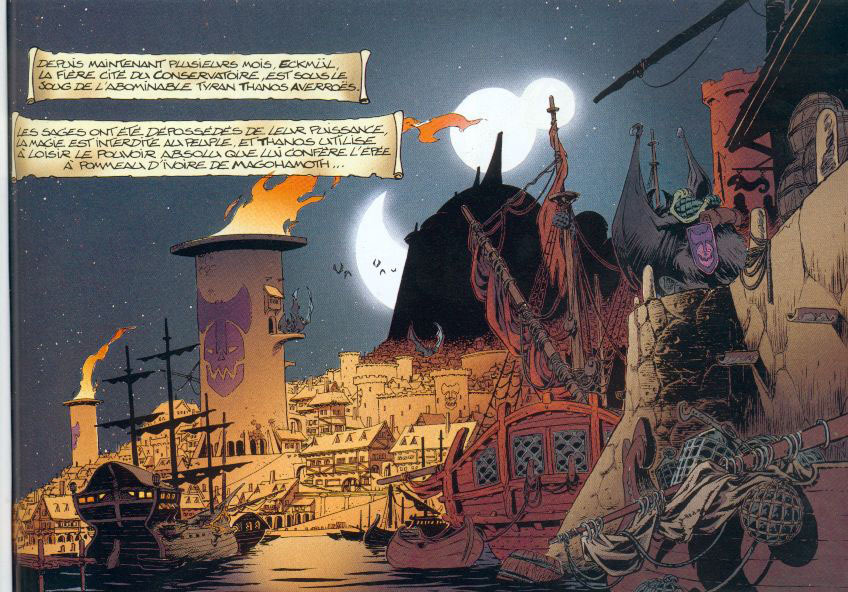
A rather confused artist's impression of the city


Pyresburg has stood (mostly) for nearly two thousand years (again, mostly. Damned wizards), andhas played a pivotal role in the building of a dozen empires. It is also home to a lot of pigeons. Some of whom are said to have interbred with vultures.

Theme and Mood

Theme: Light and Fire, Smoke and Shadow 
Pyresburg has always been a beacon of civilization on Spindlewick, a shining example of everything a great city can be, what the fires of progress can forge. But it is also an example of every shadow that a beacon casts, and of what can be lost if a forge burns untended.

Mood: Bustling and Self-Absorbed.
The streets of Pyresburg are crowded and noisy at all hours of the day and night, thronging with locals, and visitors from all over the Coin. Most of these visitors are merchants, passing through, or selling to other merchants, as the city produces very little raw material itself. And yet somehow, even with this reliance on trade, those within its walls care little for the goings on outside, except as the occasional fashion or fad. The city has been here, always busy, always leading and lighting the way, for what seems like forever, while the rest of the world changes and follows.

The Sights

The Pyre
An incredibly tall solid (if slightly twisty) stone tower topped with a great fire, the Pyre for which the city is named has stood on its small rocky spit, serving as a lighthouse for as long as recorded history. In times of danger it is also used as a signal to the surrounding countryside by the simple expedient of adding an alchemical agent to change the colour of the flame, and on a clear night with some elevation and a spyglass, can be seen half-way across the world.

The Pyresbaron’s Palace
Supposedly the same building from which pyresburg has been ruled for the last two millennia, the Palace has been upgraded, downgraded, sidegraded, repainted, reoriented, reverted, inverted, added on to, or in some other manner modified by nearly every Baron to take residence in it (several of whom were quite crazy). As a result it is a rambling hodge-podge of architectural styles, stuffed full of rooms that nobody uses, or for even remembers the original purpose of.
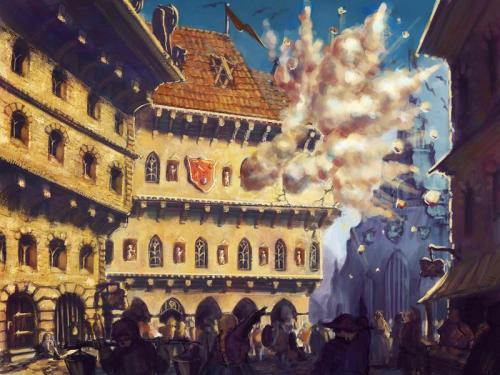
A quiet evening

The Windings
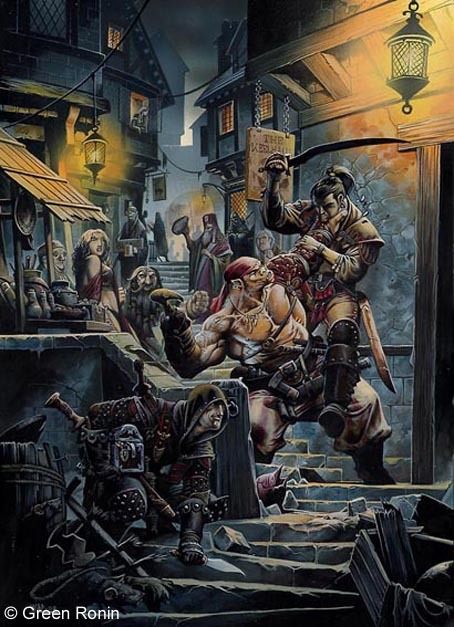
Even the most hardened warriors hesitate to enter this maze of twisty little alleyways, all alike. The majority of Hoblings in the city live here, alongside the dregs of human society, but do not be fooled into thinking that they’ve raised the property values. If anything, it has an even darker reputation than it did a hundred years ago when a mercenary giant wandered into the area and was found the next day, devoid of both his wallet and several internal organs.

The Night Market
Under the glare of the Pyre, the city never truly sleeps, and business of one sort or another continues at all hours. The night market fills several minor squares, the streets in between, and in some cases, even extending to the catacombs below, with vendors selling everything that you could find in a regular market (for the benefit of those who keep later hours), and a lot more strange or illegal things besides. 


The Drowned Rat Tavern
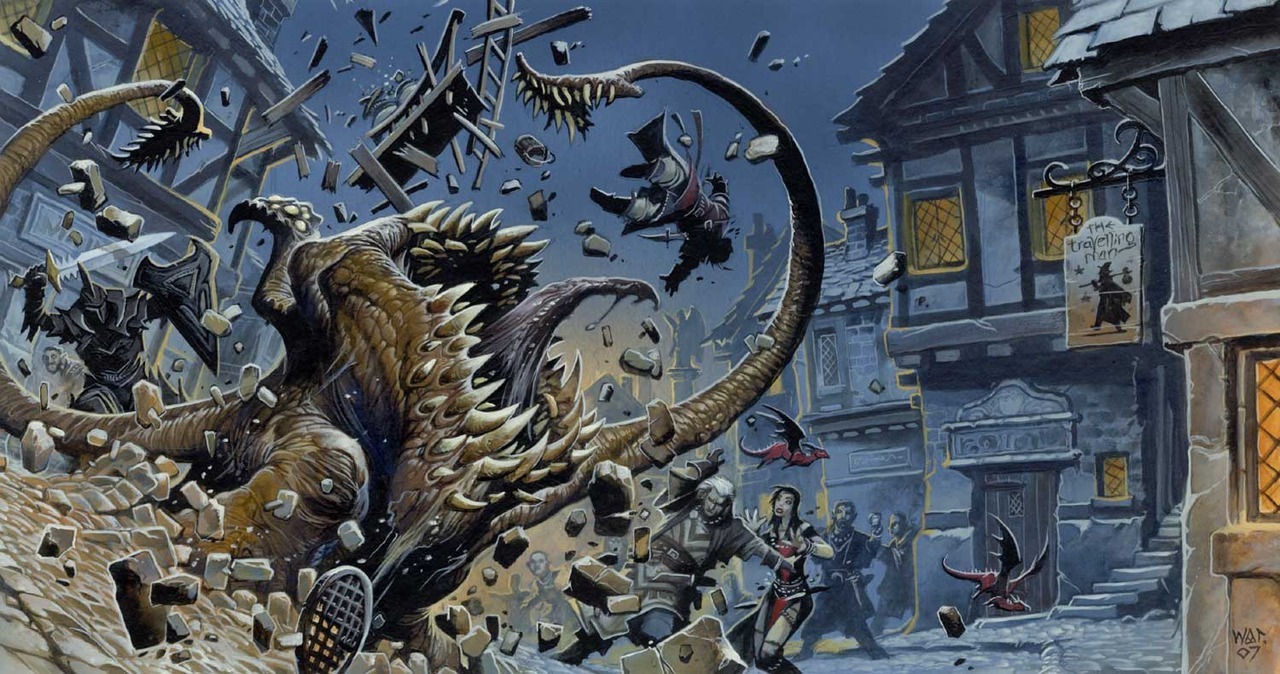
A famous drinking establishment, but sadly not for exemplary service or fine beverages. Rather, the Drowned Rat attracts daredevils and the terminally curious, as it has been destroyed seven times in the last ten years, always in unusual circumstances. Why the owner, Johann Vine, keeps rebuilding it, and how he gets the money to do so, is a mystery.


The Elvish Embassy
Maintained in unison by the Dawnwind elves of inland Spindlewick, and the seafarers of distant Yendys, the Embassy organises trade between the two elvish groups, as well as to the human nations nearby. It also provides food, lodging, and luxurious baths for elvish travellers, and an excellent location to look out over the teeming human city and feel suitably superior.


The Temple of Untold Gods
A natural out-growth of the city’s mercantile nature, ancient and varied history, and its siren song to all and sundry, the Temple of Untold Gods is technically run by priests of Omnia (Goddess of Everything Not Covered By Other Gods), but is in fact an omni-denominational church that rents out shrine space to new religions, and is often visited by those faithful to gods not widely known in the city. Behind the building proper is a small dump where the trappings of long-dead cults are deposited, occasionally sifted by the Academy’s theology department.


The Pyresburg Academy
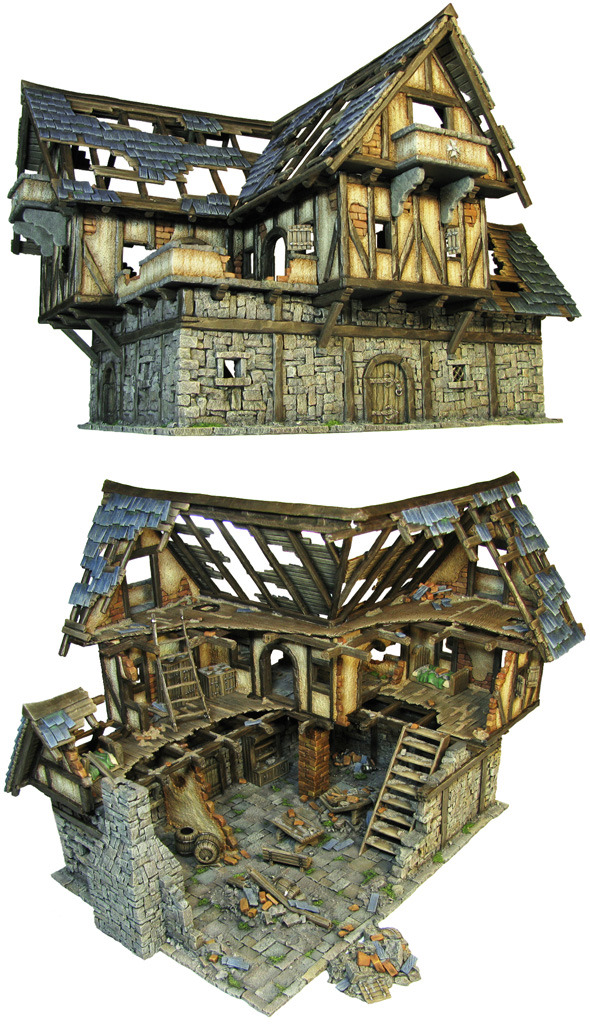
Must be Tuesday...
The oldest and most learned magical school on the Coin, the Academy was the greatest of its kind... until it burned down in mysterious circumstances 50 years ago, taking a fair chunk of the city, and all but a handful of wizards, with it. The rebuilding of the Academy has been an uphill battle, and it is still only a shadow of its former glory, but that very need to regain lost knowledge has made the Academy one of the best research institutes on Spindlewick, and a great place to sell rare books or magical devices. The locals have learned to largely ignore the periodic explosions and weird smells coming from the place.

Beneath the City
Pyresburg has existed for a long time, and the ground beneath it has taken on a consistency not unlike a Sbörk cheese – full of strange-smelling holes. Dwarf squats, Hobling warrens, basements, cellars, sewer systems both modern and long abandoned, underground sections of the old Academy (which are occasionally mobile), and older and more mysterious ruins jumble together beneath the streets. Some people tell tales of albino crocodiles that roam the underground. Those in the know scoff at such suggestions - crocodiles would be an easy meal for some of the things down there.


Yep, definitely Tuesday.

Personages of Note

PyresBaron Tiberius Hacken
A man bristly of moustache and large of ego, he considers himself a political genius, and a great patron of the arts. Most people in the know consider him a massively oblivious twit. How he’s survived nearly eight years since his election, where his predecessors died of Chronic Enemies within months is anybody’s guess.

Leonardor Doomwinch
Leonardor might well be the best dwarven engineer on the Coin, were he ever to actually finish constructing any of his inventions. Where most dwarves take pride in making a flawless finished work, Leonardor will only work on a project long enough to prove that he could hypothetically construct a perfect working construct. Of course, his designs are still incredible (if incomplete and occasionally hard to decipher), and even the basic prototypes for his inventions are marvels of engineering (if wildly unreliable), so he does not lack for patrons. There is a small industry of craftsmen in the city whose only job is to try to finish his designs, with varying success.

Daywatch Commander Lyadu Mzeze
A wandering hunter-adventurer from Zwuyala, Commander Mzeze came to Pyresburg in pursuit of a thief who had stolen a great trophy, the skull of a Zwuyalan Dire Tigerbear. Her pursuit of this criminal accidentally uncovered a smuggling ring, and caught the attention of the city watch. Intrigued by the prospect of hunting criminals through the streets of Pyresburg, she joined up as a constable, and 30 years later she is commander of the entire organization. Off duty she is a good humoured but sly old woman. On the job she is steely-eyed and tireless in her pursuit of justice.

Nightwatch Captain Thragg Turnskull.
Mzeze’s second-in-command, and Captain of the night shift, Thragg’s half-orcish night-vision and muscular bulk serve him well defending the streets from criminals. He shares his commander’s devotion to the Law, and to the City as a whole, even if most people would rather have nothing to do with somebody of orcish heritage.

Gonzo Loudfeet, Invasive Journalist.
Pyresburg is home to many thieves and spies and blackmailers. And recently, it has become home to something many consider even worse: a journalist. This obnoxious chain-smoking, coffee-skulling Hobling doesn’t even have the good grace to sell the information he purloins to the highest bidder, instead publishing it for all the world to see (or at least all the world with a spare copper or two, and the ability to read) in the daily broadsheet The Pyresburg Beacon.

Samuel Pander, Senior Firefighter Patrol.
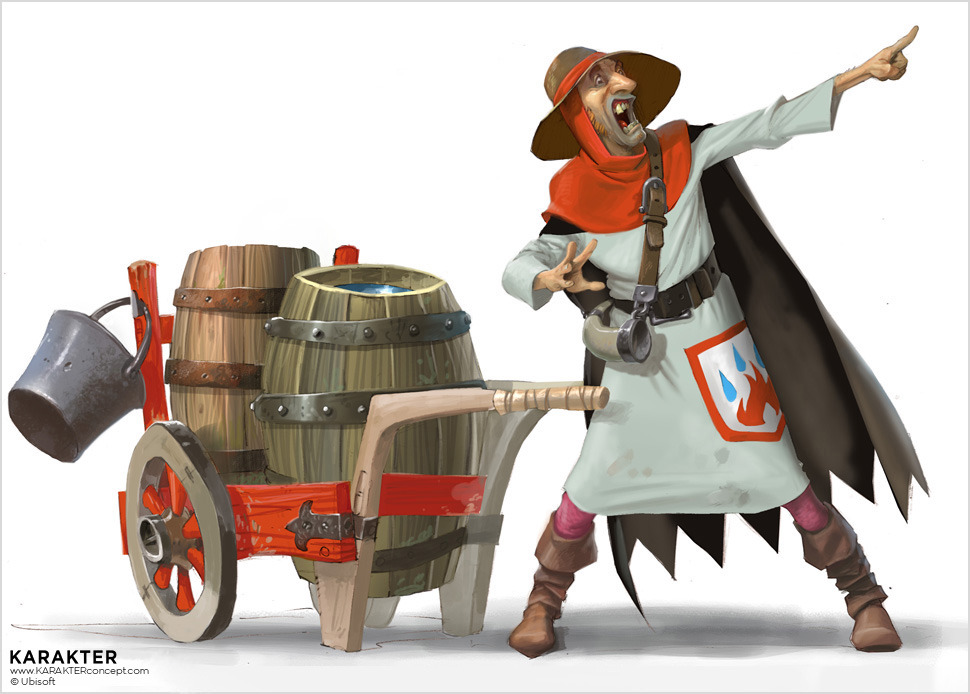
Pyresburg has been burnt to the ground a number of times over its sordid history, but it won't do so again on Sam's watch. Or so he says, at least. He may have his work cut out for him, as he's actually the ONLY member of the firefighter patrol, and has been for many years. But he continues to patrol the city, selling water to thirsty folk to make ends meet, as well as sharing the surprisingly accurate and hard to come by information he picks up on his rounds... for a price. 


Sam on a typical day.

Criminal Groups


The Guild of Red Masks
The most famous guild of “gentleman” thieves and burglars on the Coin, the Red Masks’ official headquarters is in Pyresburg, according to legend, at least. Its membership are skilled, mobile, and universally possessed of a great deal of class, stealing only the most famous of objects, and looking down at the thugs and killers that are so common among the criminal class. The only way to enter the Guild is by invitation, and the only way to get that is with a heist executed with extreme daring, cunning and flair.  

The Studded Brotherhood
At the other end of the spectrum of criminal activity is the Studded Brotherhood, named after their near-uniform of studded leather armour and helmets. This organization of thugs and assassins control crime in a fair portion of the city, and would probably control a lot more if their lack of finesse hadn't caused the Red Masks to subtly side against them. 

Fighting Organizations

Have been covered elsewhere...

Random Encounters (d12)

  1. Puzzled tourist from some far off land, probably about to be fleeced.
  2. Studded Brotherhood gang-members loitering around. 
  3. Wannabe Red Mask running from the Watch. Is aiming more for dashing rather than fleeing. 
  4. The Pyresbaron's bright red coach, surrounded by guards. 
  5. Sound of a distant explosion. Anybody nearby will mutter "bloody wizards". 
  6. Watch patrol, seemingly loaded for bear. Will be puzzled if asked why they're heavily armed, as this is standard equipment.
  7. Beggars. Almost certainly collecting information for somebody
  8. Sam Pander and his water-cart. 
  9. Gonzo Loudfeet nosing about. 
  10. Weird noises from nearby drain. 
  11. See That Random Harlot Sub-table 
  12. Fight. 50% chance scheduled bar-fight, 50% chance flashy sword-duel.

Friday, 9 December 2011

[To Coin a World] Our Dragons are... diffferent?

Inspired by the wonderful series over at Lurking Rythmically, I thought I'd type out a few words about dragons on the Coin. They're not hugely different from "standard" D&D style dragons, except where they are...

Dragons breath fire.

Of course, there's quite a bit of variation as to how they do it. Some create a high-pressure gout of flame a hundred meters long, some spit fireballs that explode, some squirt flaming liquid, and some exhale clouds of smog that they then ignite with an electrical discharge. So, while fireproof armour will be invaluable against any dragon, the fire delivery method it has can change other tactical decisions.

Occasionally something will go wrong with the internal furnace of a dragon, usually while it's growing up, causing it to exhale toxic sludge or blasts of lightning. Other dragons consider such creatures hideous degenerates and try to kill them wherever possible.

Dragons are NOT immune to fire.
Dragonhide is very tough, turning aside most weapons, and it is also magic-resistant, turning away a fair number of spells. But, while it is quite resistant to heat, it is not totally fireproof, so a dragon can wade through a burning building, but will still be hurt by the breath of a fellow dragon. Or a large pile of explosives.

Most Dragons LOATH water.
Possibly this might have something to do with the fact they're creatures of fire. Or possibly they just don't like getting water under their scales. Either way, they avoid getting wet whenever they can. This is, in fact, why most dragons have their lairs in caves or dungeons rather than places open to the sky - while being able to fly straight up would be a huge tactical advantage, no dragon is going to sleep somewhere he might get rained on.

Having said that, they're not allergic to it or anything. In fact, if a dragon can overcome it's dislike of the substance, their sleek shape, huge lungs, and vast strength make them excellent swimmers.

Their life-cycle is very uneven.
It takes a dragon only a month or two to grow from a two-foot-long hatchling to a small-house-sized monstrosity, a period during which they are constantly hungry, and will eat literally anything in their immediate vicinity that they can chew (which, considering how hard their teeth are, is basically anything at all). However, once they reach that size, they grow very slowly. As they age, they get bigger, smarter, and lazier. Thankfully for the people of the Coin, once they reach a certain size, the dragon's internal systems seem to become self-sustaining, and they refuse to actually wake up for anything less than a direct attack on their person.

They're Magical, but can't do magic
Dragons are very magical. That's why they can fly despite their weight, can breath fire, can grow scales as hard as steel, and so on. It's also why they have such a huge variation in physical construction within the one species. But, like most inherently magical species, they can't actually cast spells like a human wizard (in fact, it might actually be humanity's lack of inherent magic that lets them do that, but that's a theory for another day). They certainly cannot change shape at will.

Wednesday, 7 December 2011

Arrows of Dragonslaying

Dragons are hard to kill. This really shouldn't surprise anybody. I mean, they're giant armoured flying lizards. Clearly any prospective dragon-slayer, or for that matter, any king with a large treasury and a smidgeon of healthy paranoia, will want something to use as an equalizer in a prospective battle.

Setting aside converted siege weapons, asbestos-coated armour and the rare wizard both powerful enough to battle a dragon and crazy enough to try, the best equalizer are magically prepared arrows of dragonslaying.

Admittedly, the name is a bit of a misnomer, as they can't actually kill a dragon except by a truly lucky shot, but unlike normal arrows they entirely ignore the dragon's ridiculously tough hide, and cause debilitating pain quite out of proportion to the amount of damage they inflict. These features are what they're sought for. Being able to hit a dragon's armour and still cause it to fall out of the sky from sheer shock is a big help.

Perhaps ironically, they're quite rare due to the fact they're made out of dragon parts.

Before the magic spell that imbues the arrows with their power can be cast, the heads of the arrows have to be made from dragon claws (in case you were wondering, a given dragon has from six to twenty-two claws, depending on its physical layout).

The next stage, once the heads have been made and affixed to a suitable shaft is to soak the arrows in the still-warm blood of a recently killed dragon.

Because the claws are even harder than the dragon's hide and filing them down to the proper shape can take days, and the blood cannot be more than half an hour old, for every quiver of arrows, two dragons have to slain.

Which explains why they're so amazingly expensive.

Sunday, 6 November 2011

The Icebone Wand of Arng-Duvool

(this item came about thanks to my ruminating on One-Ring-Like artefacts in D&D-like campaigns, and how one has to make sure they're more dangerous in the hands of the bad guy than they are useful in the hands of the PCs, otherwise the whole dynamic shifts a heap, and you're dealing with a different kind of scenario)

Believed to have been crafted from the thighbone of a god or demigod, killed to free the world from the last ice age, the Icebone Wand of Arng-Duvool holds vast magical power, far beyond that of most mortal mages, and can be wielded by any being who possesses the will to do so, even if they are not themselves a mage or wizard. It would be the ultimate weapon, did it not possess a severe flaw: when its power is used, it saps heat from the user. Even a small manifestation of its magic can leave a wielder shivering and in desperate need of a warm fire, and any serious spellwork will cause frostbite and hypothermia, or even death by flash-freezing.

But for a lich, an undead abomination composed of only a skeleton, unable to feel winter's chill, the wand would be the ultimate prize...

Tuesday, 25 October 2011

To Coin a World: Genie Servants


Most adventurers know of Genies, how they are magical beings from another plane, and that they can be bound to serve mortals, even granting wishes.

Fact is, most adventurers outside Aratha have no idea how the nitty-gritty of all that works. They assume that genies are just like demons.

They're not. While a demon can be bound by magical circles, and compelled to perform services, either for free or in exchange for sacrificies, depending on the power of the binding wizard, genies cannot be bound by wizards at all. They can be summoned, but are under no compulsion to obey the summoner.

However, genies have rituals known only to themselves that can bind other genies, forcing them to serve whoever possesses a specified binding object, usually a lamp, amulet or ring. Genie lords often trade these indentured slaves to wealthy Sultans or powerful sorcerers on the mortal plane, in exchange for goods or magic that can't be found on the genie's home dimension.

Occasionally a noble genie will be bound to grant wishes. This is reserved for only the most hated enemies of those doing the binding. Wishes can only be granted on the mortal plane, and each wish granted tears away a third of the genie's very essence, with the third wish either killing the genie, or leaving it a withered husk. Understandably, these genies are bitter, and will twist the wording of wishes to cause as much pain and sorrow on the wisher as they can.

Tuesday, 18 October 2011

A thought about local linguistics

Recently I've been studying the Late Middle Ages/Renaissance, in particular in Italy. It's become increasingly apparent that 1: it's a great time and place for gaming, and 2: I already knew that, sort of, because how I've always imagined Pyresburg and various other bits of the coastal area near the Friendly Sea sort of matches up with what I'm learning.

Except for the names. The few locations I've actually given names that my players are aware of (the few-ness being a problem I need to fix...) sound like what they are: compound words, or purely made-up stuff. In both cases, chosen by somebody who can only speak English, and horrifically anglicizes any foreign words he comes across. What they don't sound like is Italian.

But maybe there's a (hastily ass-pulled) reason for this: they're "translated" to make them sound like they originated in the player's native tongue, much like in the game-world they originated in the character's native tongue and don't sound like they're "foreign".

Would you buy this explanation as a player? Have you used similar explanations before? Have I adequately explained my thoughts?

Monday, 18 July 2011

[To Coin a World] The Disenchanted Forest

Spindlewick, the major hub-continent of the Coin, is covered in forests. Most of them are enchanted, and are positively lousy with fairies, unicorns, and other obnoxious and highly-magical beings. Against this magical backdrop, one region stands out - The Disenchanted Forest. The area is completely devoid of magic. Spells do not work under its eves, enchanted items are useless, and magical beings lose any magical powers and properties until they leave the wood.

Encounters in the Disenchanted Forest:
  • A completely normal, non-talking, non-mutated animal.
  • A rather confused lycanthrope that has become a completely normal man, at least temporarily. Probably looking for some clothes.
  • A group of wizards doing research on the area. Their spells don't work, so they're carying ridiculous amounts of armour and weaponry to compensate. They're very jumpy, because they can hear off in the distance...
  • A tyrannosaurus rex. It used to be a dragon. Now it's very stupid, and very angry.

Tuesday, 10 May 2011

Fighters of Pyresburg

Pyresburg, jewel of the Grand Reman League, is a city renowned for many things. It's arena is not one of them. A dilapidated ruin, it hasn't seen use in over a century. Yet the populace still have the bloodlust of the old Reman Empire. So how do they get their fix of stylized public violence? Two different groups, near antitheses of each other...

The Barfighters' League.
The rich folk of Pyresburg have a strange relationship with the poor. On the one hand, they hold themselves aloof, but on the other, they find many of their "quaint" traditions fascinating. Combine this with dilettantish boredom and a surfeit of money to gamble and the end result is nobles ensconced in private booths of seedy bars, watching professional barfighters duke it out, and gambling on the outcome. The fights are staged, but for all that various crime bosses try to rig them, the fighters are usually too drunk, stupid, or dedicated to their violent art to be relied upon to follow orders in the heat of a brawl. They will, however, usually follow the rules: no weapons (except for bar fittings), no spells, no bothering the rich folk.

The Duellists' Association
Conversely, the poor are always interested in how the high-flyers act. Even how they fight. Many nobles train as swordsmen, and will challenge each other to public duels over the most minor slight. These duels are almost never (intentionally) to the death, and are mostly about showing off and gaining the adulation of the crowd. Official Association Rulekeepers watch such fights and will declare a winner on points, based on style, technique, flourishes and sportsmanship.

Members of both groups despise the other, although their fighting styles share a great deal of theatricality. Adventurers could combine them to great effect in combat, although they would be jeered at mercilessly by any "pure" fighter


Thursday, 20 January 2011

Idwinmor's Items of Interesting Inchantment

1. Nym's Wandering Hands: a bag containing 2d4 animated severed hands which will follow verbal commands of whoever holds the bag.
2. Shield of Sliding: a +2 large shield that, when stood one, will slide across any surface almost frictionlessly.
3. Brassiere of Fire Elemental Control (aka The Burning Brassiere): allows the summoning and control of a fire elemental while worn. If the user is male, the elemental will commend him on his open-mindedness and willingness to ignore conformist notions of gender-specific clothing.
4. Bottled Ocean: when uncorked, water pours forth from the bottle. The ornate silver stopper comes loose at the slightest provocation.
5. Amulet Collection of Protection: a huge number of minor protective amulets all tangled together. Collectively they count as a +1 protective item, but they weight nearly a stone, and if disentangled from one-another they lose their powers (which may not actually be magic so much as the sheer mass of amulets will absorb attacks...).
6. Wizard's Hat of Disorganized Storing: comes in a variety of styles, and weightlessly store any item that will fit through the head opening. When reaching inside, a random item from those stored is retrieved.
7. Mask of Disguise: a simple domino mask. Unless a person actually sees the user don or remove the mask, they will never realize the identity of the mask-wearer, no matter how distinctive the rest of their appearance is.
8. Scroll of Tavern Portal: user and up to seven companions are instantly transported to the nearest location with a sizable quantity of alcohol on hand. The user may activate the scroll a second time to return all those effected by it to their original locations.
9. Cursed Chainmail: this +2 chainmail works like normal, so long as it is given to a new user every week. If not passed on within that time, the wearer takes double damage from all attacks until the armour leaves his possession.
10. Boots of Exhausting Speed: when activated, the wearer moves at twice his normal speed. Afterward the wearer must rest, and cannot take any action (aside from gasping and wheezing) for a period of time equal to the time spent running.
11. Silent Ring: the wearer cannot make noise of any kind while the ring is worn.
12. Errol's Rope: this rope with attached grappling hook can be hung from a point in thin air.
13. Winged Boot: would allow the wearer to fly with perfect maneuverability and great speed if found in a pair. This singular boot instead allows the wearer to fly at their normal movement speed, with all the grace of a drunken cow.
14. Loadstone Pauldron: a hefty shoulder guard that can be attached to any metal armour, giving it a +3 magic bonus. However, all attacks from metal or metal-headed weapons that miss somebody adjacent to the wearer will be re-rolled and applied to the wearer.
15. Eon Brandy: this bottle of alcohol is older than recorded history, and is so strong that if uncorked the mere fumes will render everybody nearby drunk. Actually drinking it would probably be lethal to most mortal beings.
16. Nevermiss Sword: a +3 sword that, on a miss, makes another attack against a random target within reach (this can include the original target, the wielder's allies, and even the wielder himself). New randomly-targeted attacks are made until the sword actually hits somebody.
17. Tiara of Timeliness: the wearer does not age in any way, and is immune to all damage, attacks, and anything that would change the wearer. However, when the tiara is removed, all such effects catch up.
18. Shoe Souls: These rune-stitched shoes can each bind the soul of a being that dies in the presence of the wearer. The shoes may be questioned by the wearer (but are under no compulsion to answer him). Smell faintly of ectoplasm.
19. Butterfly Sword: a +5 sword that deals no damage on a hit, but instead explodes into a cloud of butterflies, distracting the target. The sword reforms in the owner's possession at the next dawn.
20. Eric's Excellent Knife: will cut through ANY non-living thing, given a few minutes, or hours, depending on the material in question. In combat, works as a normal knife, but will reduce the target's armour bonus by 1 with each hit, due to bits being cut off.

Sunday, 7 November 2010

[AW-style move]Recall a Cure

Recall a Cure (d20+Knowledge+Mind)
Roll when a party member is afflicted by some horrible condition (such as a curse, disease, or whatnot), and you need to remember how to cure it.

14-: the GM picks one option from the following list.
15-19: as above, but the player picks instead.
20+: the players gets to pick three.

  • The cure is nearby, and won't take a long journey to reach.
  • Acquiring the cure will not require spending much money.
  • The process of getting the cure will not be overly dangerous.
  • The party won't owe anybody any favors in exchange for the cure.
  • The process of getting the cure will give the party some other benefit in addition to its restorative properties.

Sunday, 24 October 2010

Microlite20/Troubles and Treasures House Rules

I was recently lamenting the fact that, due to all the changes I and my group have made to MicroLite20, I can't just point to a single document and say that that's our rulebook. So, I decided to list the main rules changes we've made as succinctly as possible. Unless otherwise stated, everybody conforms to the original m20 rules available here, or here, by Greywulf.

Races:
In addition to Humans, Elves, Dwarves and Halflings (Gnomes), there are also Half-Orcs (+1 Str, +1 Phys and Sub), Planetouched (+1 Mind, +1 Know and Com), and Constructs (+5 on saves against poison, disease and suffocation/drowning).

Feats:
every odd numbered level opens up a feat slot. What feats you can take are determined by race and class, but you don't get a feat automatically. Sometimes a feat needs to be learned from a teacher, sometimes you pick it up to replicate, long-term, something the GM let you do on a special occasion. A compilation of feats will be forthcoming at some point. Until then, this is an optional rule.

Rogues:
sneak attacks deal an additional 3+level damage (this is not connected to the Rogue's Subterfuge bonus).

Fighters:
no change.

Wizards:
Wizards can use books, wands and staffs as focuses for magical energy, working like ranged weapons (light crossbow, shortbow and longbow, respectively). They get no favoured/signature spells (but spells are cheaper, and they have more hp, see below).

Performers (Bards):
Get 2 + level + Mind bonus uses of their music per day. By default they can use music to charm individuals, hypnotize crowds, and counter other sound-based effects, and can do other things with the right feats. They can wear light armour, and get +2 Subterfuge, Knowledge, and Communication.

Invokers (Clerics):
Get no spells or turn undead uses, but get to pray without any penalties, and with an optional re-roll. They can also tend to another character, allowing them to make a new save against an on-going non-permanent effect, or to spend a healing surge with a re-roll.

Combat Actions:
Use the normal D&D 3.5 system of 1 move action, 1 standard action, or 2 move actions, or one full-round action.

PC Hit Points:
Are rolled using a d8. Every character gets 4 healing surges plus their Strength bonus, per day. They may spend a healing surge as a standard action to heal 1d8 lost hp. Any healing effect will require the usage of a healing surge.

NPC Hit Points:
Are either 5 per level for "mooks", or 10 per level for "boss" monsters/characters encountered on their own. NPCs have healing surges, but most can't use them unless they have some outside effect working on them (such as a cleric). The GM will say when an NPC gets down to half it's hit points (is "bloodied").

Skills:
Skills are equal to the character's racial and/or class bonuses, plus half their level, rounded up.

Attacks and Damage:
Attacks are divided into Strength attack (non-light melee weapons), Dexterity attack (light melee and thrown weapons), and Mind attack (bows, crossbows, firearms and spells). Each is the relevant ability modifier plus the character's level. There are no iterative attacks, although dual-wielding works as in the M20 books. Additionally, characters add half their level (rounded down) to their damage rolls.

Spells:
Adventuring wizards know all the spells in the Adventurer's Spellbook, and can learn/create more, although the highest level of spells that is possible is level 7. Spells cost 2 hp per spell level, minimum of 1 hp. This damage is normal damage, and can be healed by anything that normally restores lost hp. If a spells is experimental, or of a spell level too high for the wizard (greater than character level+1, halved), there is a 50% chance the spell will backfire and do something weird and random. Otherwise that only happens when the wizard rolls a natural 1. Spells cast through prayer work the same way.

Carrying Capacity:
Objects are weighed in Stone (14 pounds, or 6 kilograms), rounding off, with 1000 coins weighing a stone. A character can carry half their Strength score in stone, rounding up, without any trouble. More than that can only be carried for short periods.

XP and levelling:
XP is handed out for fights, carousing, and eXPloration. Characters have to achieve something to go up a level (defeat a worthy foe in a new way, commit a new crime, learn a new spell, spread fandom/religion to new people, or something along those lines).

Monday, 9 August 2010

[Microlite20] The Alucard School of Serious Swordplay

Most fencing academies on the Coin focus on pure swordplay - that is, dueling against opponents armed themselves with swords. The École d'Alucard in Languille, in contrast, is a far less traditional school. Recognising the more complex dangers of the modern world, the École d'Alucard arms its students with the techniques and talents necessary to brandish their blades in battle against a wide range of opponents - axe-wielding orkish barbarians, duergar musketeers or even in the more advanced classes, tentacled monstrosities of death.

Fencing Feats for Fighters


Fencer's Fancy Footwork
Prerequisite: Nimble Sworsdman
When wielding a one-handed blade, you may move one square whenever an enemy misses an melee attack against you. (immediate action)

Unconventional Parrying Technique
Prerequisite: Fencer's Footwork
Once per turn, you may choose to parry any melee attack against you. Roll an attack roll. On a 15+, you parry the attack but may not make any attacks in the next turn. On a 21+, you parry the attack and can attack in the next turn.

Alucard's Anti-Archery Adaptation
Prerequisite: Unconventional Parrying Technique
You can use Unconventional Parry Technique against ranged non-magical attacks.

Tentacle Slashing Slayer
Prerequisite: Unconventional Parrying Technique
You can try to remove a creature's arms and tentacles as a standard attack. Roll an attack roll. On a 15+, you only slightly wound the creature, forcing it to recoil somewhat. It cannot use its limb next round. On a 21+, you severe the relevant limb and deal damage as normal.

Tuesday, 29 June 2010

Other Weapons in the Goblin Arsenal

As you might have noticed from my post here and my follow-up here, I like using goblins. Particularly Warhammer/Magic the Gathering-esque ones that use crazy techniques to attack the PCs. Apparently, some other people like them that way too, as I've found three nifty links to new ways for goblins to be deadly, silly, and annoying all at the same time:

Thursday, 27 May 2010

Doodle Dungeons

Made during boring moments at work.


I've since been informed by John that I should make them smaller, as he prefers microdungeons. Good thing for him I've got work next week.

Wednesday, 19 May 2010

Grudgeball

The continent of Spindlewick has seen a lot of wars over the eons. Just about everybody has had a go at everybody else at some point. You almost can't fire a ballista without hitting an old battlefield.

Obviously, at some point, the High Druids decided that all this probably wasn't so good for the bits of landscape playing host to the battles. After some petitioning, and possibly a few battles of their own, involving magically animated trees, they managed to get most of the sides involved to agree to only start wars over "proper" things, like territory, farmland, kidnapped royalty, and suchlike, rather than any time a king felt the national ego could do with a boost.

For times like that, there is now Grudgeball.

Grudgeball is usually played on a large oval or square field. Two teams of of players try to hit the ball (actually a goblin skull alchemically treated to give it bounce) through the opposing team's goal hoop using hefty wooden mallets. A Druid referees, and makes a vain attempt to enforce the "no intentionally hitting other players with your mallet" rule. The ball may be handled with the mallet, or the head or body of a player, but not the feet or hands.

A Grudgeball team is made up of 11 players, 8 of whom may be on the field at any one time. Up to two of these players may be "heavies" (defined as anything that's more than 10 feet tall when it stands up straight, or that weighs more than 25 stone), with the special limitation that if both heavies are deployed on the field at once, if one is incapacitated or sent off, their "slot" must be left open, and not filled with a normal player from the bench.

Arcane magic is usually banned on the field, but divine magic is permitted (on the grounds that nobody is willing to tell a god he's not allowed to get involved), although smiting of players is generally considered bad form. Intentionally enchanted mallets and other items are likewise banned, although some relic mallets that have picked up a sort of ambient enchantment from the belief of the fans do see use (and get stolen a lot by rival teams), and golems and reanimated dead are permitted (on the condition that they can say "I am a player" to the Druid referee).

Games usually last an hour, or until a riot breaks out.

Wednesday, 5 May 2010

The Coin

The world is flat. Any fool can tell you that. Of course, long ago, the fools of a past age thought it was flat like a shining coin, soaring through the void with its three luminous moons like some mad god's lost change.

The discovery of a bunch of elephants and a planet-sized turtle adhered to the other side of the "Coin" kind of upset this theory, but sadly, by then, the name had stuck.

So, this is my campaign world. A little Discworld*, a little D&D kitchen sink, far more planning than is healthy, and far less planning than it seems to warrant. The map above was originally created by TheLoneAmigo, then got tweaked by me (you can blame me for the horrible shade of orange on the deserts, him for the place names).

*which is to say, a lot Discworld.

Monday, 26 April 2010

Flight spells on the Coin

A long time ago the gods made it pretty clear that if the mortal races were supposed to be able to fly they would have been issued wings up front. After some lightning bolts were thrown around, the wizarding community got the hint and gave up on spells that allow humans to soar like birds.

Of course, wizards are smartasses. They've since worked out a myriad of spells that do similar things without breaking the "no flying mortals" rule. Feather Fall will slow your decent, Levitate will allow some vertical movement without actually counting as flight, and finally, the coin version of the spell Fly actually imbues aerial mobility on a broom* which a mortal spellcaster might just happen to sit on...

*or carpet, or staff, or cauldron. Different cultures have different versions with different degrees of speed and stability.

Thursday, 25 March 2010

A Thought on Goblin Warfare

Goblins, generally, can be found to be wielding one of four types of weapon

Firstly, there is the wickedly curved (or wavy) sword. This is the mainstay of goblin warfare, largely because they're vicious little buggers who love causing hurt to anything around them.

Second, there is the spear, or, more often, the Pointy Stick. Typically wielded by goblins who are vicious, but either have some modicum of self-preservation instinct, or are just too slow to get the any of the "good" spots up the front.

Third there is the bow. Beware the goblin bowman, because he lacks the kind of craziness requires for front-line fighting, and thus might be capable of some actual tactics and proper target selection. Particularly nasty are those bowmen who have the skill to coat their arrows in hallucinogenic poisons.

And lastly, but by now means least, no matter how silly it may seem, there are those goblins who go into battle armed not with a sword, or a spear, nor even a bow, but with whatever they can pick up and throw. This is a problem, because as these are often the craziest goblin, they will often select rather dangerous missiles, such as flasks of burning oil, or rabid rats.

Or, occasionally, rabid rats covered in burning oil.

Saturday, 19 December 2009

Old-School-Ish Random Treasure

Over the last couple of years, I've become increasingly irked by the concept of wealth by level, and treasure by challenge rating existent in 3.x and later editions of D&D. I mean, sure, it might be good game balance, but it leads to situations where the average goblin is walking around with more wealth then a dozen peasants.

Which is why, when I first saw it, I was quite enamored with the Basic/OD&D idea of giving each monster a rated treasure type, dependent on who likely it was to actually collect loot. You would look up the type on a table, and roll to see whether it had any of a variety of things. Sometimes you got nothing, sometimes you got a huge horde. Of course, this was back before you could, let alone needed to buy magic items, so a heap of coin wasn't quite as useful, and it wasn't such a huge deal if a bunch of 1st-level characters found 15,000 gold coins in a goblin den.
Of course, after a while, I started to find some drawbacks to the system - the rating was per lair of monsters, which meant getting treasure for smaller bands was fiddly, and the whole thing required tables to be looked up. I wanted something simpler.

So, here I present a compromise. It's a sort of homogenized version of all the assorted treasure types collected by most humanoid (or humanoid-ish) critters in basic D&D, and comes out pretty close on an average-value-per-hit-dice-of-monster comparison.

For every 13 hit dice (give or take) of monsters in a dungeon, roll once for each category. The % numbers are the likelyhood that type of treasure will be found. The number after that is how much/many of that treasure type will be found.


(click for larger view)

Special treasures are things that don't fall into the other categories, like expensive wines, stockpiles of armour, rare books, etc. I may do a post about my own personal special treasure tables at some point.