Showing posts with label random tables. Show all posts

Friday, 29 June 2012

Marx & Monsters: Burning the City


In service to my prior post, I wanted a City Burner in the mode of Judd Karlman's MoBu City and Build Your Own New Crobuzon. You can use it to build the skeleton of your own dystopian metropolis, or to provide inspiration for extending an existing world. In this post, I focus on the structure of the City as a whole; a later post will cover mapping the City as individual districts and landmarks. Choose to use it as a random generator, or purposefully select items from each list, as you prefer.


Despite all its horrors, the City is a baroque, impossible, wonderous place. Few will choose to leave it willingly; fewer still will fail to return. Choose (1d20) one, two, or three phantasmagorical traits that set the City apart from any other metropolises that have been or will ever be:
  1. ...it floats in the interdimensional space between the planar spheres.
  2. ...it consumes other cities, leaving only ruins behind.
  3. ...it walks across the face of the world, hauling its bulk on thousands of legs.
  4. ...it grows from the corpse of a dead god.
  5. ...it was built on the back of an immense beast.
  6. ...it fell from the heavens.
  7. ...it stands upon the border of Hell itself.
  8. ...it lurks within an immense dark cavern, beneath the surface of the world.
  9. ...it towers miles into the sky.
  10. ...it is an animate, living thing, with a mind of its own.
  11. ...it rules a vast empire built on blood and iron.
  12. ...it never stops raining here.
  13. ...it lies beyond the reach of sleep and dreams.
  14. ...it is filled with a thousand portals to a hundred worlds.
  15. ...it lies deep beneath the sea.
  16. ...it was built from the dreams of a lone madman.
  17. ...the walls between the realms of life and death are thinner here.
  18. ...the streets constantly shift and move, like a living labyrinth.
  19. ...the world has already ended, and the City is all that is left.
  20. ...it wraps back in upon itself like an ouroboros. 
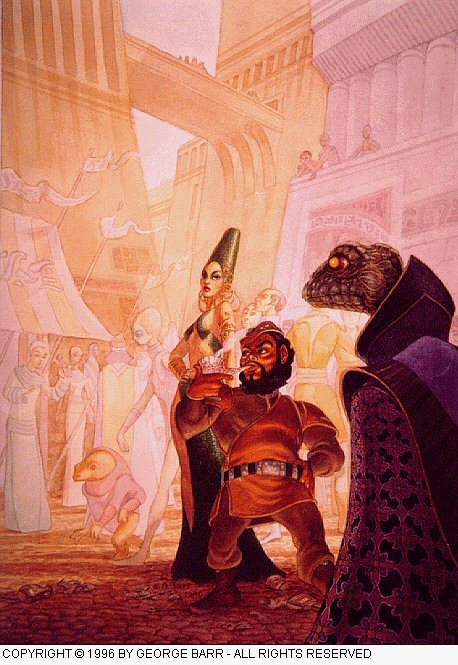

The City plays home to a host of cultures and species, a melting pot that boils everything down to its lowest common denominator. Humans call the City home, of course, but many other races do as well. Perhaps they form part of the ruling classes, perhaps they are victims of a speciest government that treats them like slaves, or perhaps they are just people. Pick (1d20) at least three non-human sapient races that make up large portions of the city's population:
  1. Orcs, hot-tempered, thick-skinned, and often cruel.
  2. Scarabae, beetle-kin with a taste for precious jewels.
  3. Yuan-ti, descendants of men and snakes with a poisonous bite.
  4. Fomorians. hulking giants with the blood of the unseelie.
  5. Abeil, hard-working bee folk from a distant plane of existence.
  6. Litorians, powerfully built leonine people with a nomadic past.
  7. Kobolds, scavengers with the blood of dragons in their veins.
  8. Minotaurs, bull-headed, stubborn, and with a penchant for labyrinths.
  9. Myconids, fungoid creatures who cannot form human words.
  10. Aranea, shape-shifting great spiders with a talent for textiles.
  11. Salamanders, flame-blooded and serpentine.
  12. Lycanthropes of several different breeds.
  13. Ghouls, undead scavengers with a savage hunger for flesh.
  14. Anubians, jackal-headed stone constructs given life through arcane means.
  15. Wyrmen, pigeon-like flying creatures with a rudimentary intelligence.
  16. Tritons, fish-kin who live in brackish coves beneath the city.
  17. Drow, long-banished elf-kin who abhor sunlight.
  18. Tieflings, humans touched with the blood of the infernal planes.
  19. Yoon-Suin, slug-kin, immense strength tempered only by their slowness.
  20. Choose any other race from your favourite compendium of creatures.


Corrupt plutocrats and patricians form the majority of the city's ruling class, but they do not rule alone. There are many interlocking gears in the machinery of oppression. Choose (1d10) two or three other major power groups who hold great influence over the City's leadership, either openly or in secret:
  1. A nest of vampires (desire: to feast off the life-force of the populace)
  2. The corrupt elders of a major faith (desire: to rule the hearts and minds of the populace)
  3. A coven of dream-witches (desire: to rule the world of dreams)
  4. A cabal of wizards and sorcerers (desire: to plumb the depths of knowledge)
  5. A cult of hedonistic demon-worshippers (desire: to revel in causing suffering)
  6. A powerful spirit of law (desire: to ensure obedience and conformity)
  7. The military leadership (desire: to wage war)
  8. A prominent devil with a quota to meet (desire: to ensure a healthy supply of damned souls)
  9. A major criminal syndicate (desire: to accumulate and hold power)
  10. A truly ancient dragon (desire: to hoard wealth)


Life in the City, for most of its impoverished inhabitants, is a dire struggle for one's daily bread, caught in a constant cycle of debt and near-starvation, living from one day's wage to the next, surrounded by suffering, disease, and crime. The City, however, is not content with the relatively mundane horrors of permanent crushing poverty, inescapable debts, and class-based oppression. Choose (1d12) two or three bizarre inhumanities that are imposed upon the population by the status quo:
  1. Constant thirst: The supply of drinkable water is controlled by plutocrats, who charge through the nose for the basic substance of life. Vast swathes of the population are constantly on the verge of death from thirst, while the wealthy cavort in bath-houses and fountains.
  2. Forced undeath: Necromantic rituals are used to transform corpses of the proletariat into a tireless zombie workforce. Often, labourers are worth more as dead corpses than living beings, and the truly impoverished can be forced to sell themselves into undeath to provide for their families.
  3. Flesh-warping: Those convicted of a crime, or who fall into bankruptcy, become the property of the City. They are subjected to flesh-warping sorcery by the City's justice system, either to shape them into better slaves, or to provide ironic punishments for their crimes. Worse yet the gardens of the truly wealthy are filled with living sculptures; sapient beings sculpted into obscene abstract bodily forms.
  4. Industrial sacrifice: Ritualised murder powers the City's industrial district. Criminals and debtors are the first to be fed into the maw of progress, but its hunger never yields. Sometimes, entire city blocks are cordoned off, the inhabitants carted away to be fed into some horrific eldritch machines.
  5. Arcane experiments: Impoverished citizens have no rights when it comes to the pursuit of arcane science. The poor are regularly subjected to horrific experiments, and most diseases that sweep through the tenements are engineered by pestilence mages from the City's most prestigious magical academy.
  6. Travel restrictions: Peaceful transit through the city is regulated by a series of obscure codes and travel zones. Certain classes of citizen are prohibited from travelling through certain zones at certain times, and anyone found in the wrong district at the wrong time is subject to the full horrific force of the City's justice. 
  7. Body-theft: The wealthiest amongst the elite of the City can live forever by buying up the bodies of young criminals and debtors. Either consciousness can be transferred across bodies, leaving the poor in the broken near-corpses of City elders while they cavort in young and shapely forms, or the City's elite are in fact mental parasites that subdue the consciousness of their hosts.
  8. Endless conscription: The City's leaders are engaged in a constant and unyielding struggle with a foreign power, and their war machine cries out for fresh blood. Those who are conscripted and remade into soldiers or worse will never return, or at least not in any form recognizable to those who once knew them.
  9. Dream control: Even in deepest sleep, oppression cannot be escaped. The shadowy guardians of the City walk through the dreams of the sleepers, searching for hints of rebellion and seditious thoughts. Sleepers can even be forced to work off their debts in dream-labours towards mysterious ends.
  10. Memory markets: In the City, debts can be absolved and crimes forgotten in exchange for your memories, which can be sold on the open market to the highest bidder. It's not unknown for a pauper to sell the memory of their dead mother to pay for a cup of coffee, or the memory of a lost love to pay the month's rent.
  11. Drug-induced prayer: The alchemists and priests of the City have discovered how to produce an addictive drug known as Faith, which induces a state of heightened religious ecstasy. The prayers of a million addicted labourers are channelled as raw power into the temple-factories and eldritch workshops of the City's industrial districts.
  12. Blood money: The economy of the City is quite literally built on the blood of its citizenry. Pints of blood are a common unit of exchange to be bought and sold like milk or honey. Taxes, rents, and debts can be forgiven in exchange for a few minutes with a needle and bottle. In the poorer districts, pallid skin and fainting labourers are everywhere, drained of their very life-force by the machine.


Not everyone is content to allow the elites free reign, to simply lie still while they are crushed beneath the gears of capital. The City's underground is awash with revolutionary groups who aim to break the status quo, or defend the rights of the proletariat. The list below includes some of the possible groups that might make up this underground. Choose (d6) at least one revolutionary group that is actively being crushed by the enforcers of the status quo, and at least one revolutionary group whose leadership have abandoned their goals and become co-opted into the regime:

  1. A powerful trade union (desire: to win rights for workers).
  2. Anarchist street gangs (desire: to bring down the state).
  3. Radical street journalists (desire: to expose the truth).
  4. Liberation theologists, declared as heretics (desire: to protect the impoverished).
  5. Civil rights activists (desire: to win equality).
  6. Artistic revolutionaries (desire: to display the truth through art).


The leaders of the City do not generally dirty themselves with the messy business of enforcing oppressive laws and controlling the people. Stamping boots across the face of the citizenry is left to militiamen, secret police, and mercenaries hired by industrial cabals and underworld syndicates. These enforcers are well versed in the language of fists, batons, and torture, but they wield other tools as well. Choose (d10) at least two strengths of the City's enforcers:
  1. Ironwatch: Street-level enforcers are automata and constructs, immune to bribery and firmly under the control of the central commanders.
  2. Changelings: The secret police employ changelings who can take any form and infiltrate any organisation.
  3. Enforcer beasts: Horrific beasts are kept under control by the city guard, to be released upon criminals and rioting citizens at will.
  4. Noxious alchemy: The city guards have access to an array of alchemical weapons, from noxious choking gasses, to alchemical potions of strength and endurance, to batons marked with poisons that cause vomiting on contact.
  5. Compulsion: Secret police and other enforcers have access to charms and techniques that inflict magical compulsions upon their targets, mentally compelling them into certain actions.
  6. Mind flaying: With time and intimacy, agents of the regime can peel away a person's most secret thoughts and memories. The health of the prisoner is not guaranteed.
  7. Informants everywhere: The secret police use wealth and blackmail to maintain an incredible network of informants and double-agents, giving them eyes at every level of society.
  8. Judicators: The City's militia is not restrained by any formal system of justice when dealing with the proletariat; agents of the state are free to pass sentence upon offenders in situ.
  9. Panopticon: Most every public space, and many private ones, are laced with the scrying eyes of the secret police.
  10. Scent trackers: Once a target has been sighted, members of the militia are able to track them by scent through miles of winding City streets.

Finally, give the City a name, or as many names as its citizens have tongues. Haunting names that harken to lost ideals, musty names that recall ancient history, ironic names that promise a better future, or names that stir memories of revolutions past.


Next up: Mapping the City!

Thursday, 20 January 2011

Idwinmor's Items of Interesting Inchantment

1. Nym's Wandering Hands: a bag containing 2d4 animated severed hands which will follow verbal commands of whoever holds the bag.
2. Shield of Sliding: a +2 large shield that, when stood one, will slide across any surface almost frictionlessly.
3. Brassiere of Fire Elemental Control (aka The Burning Brassiere): allows the summoning and control of a fire elemental while worn. If the user is male, the elemental will commend him on his open-mindedness and willingness to ignore conformist notions of gender-specific clothing.
4. Bottled Ocean: when uncorked, water pours forth from the bottle. The ornate silver stopper comes loose at the slightest provocation.
5. Amulet Collection of Protection: a huge number of minor protective amulets all tangled together. Collectively they count as a +1 protective item, but they weight nearly a stone, and if disentangled from one-another they lose their powers (which may not actually be magic so much as the sheer mass of amulets will absorb attacks...).
6. Wizard's Hat of Disorganized Storing: comes in a variety of styles, and weightlessly store any item that will fit through the head opening. When reaching inside, a random item from those stored is retrieved.
7. Mask of Disguise: a simple domino mask. Unless a person actually sees the user don or remove the mask, they will never realize the identity of the mask-wearer, no matter how distinctive the rest of their appearance is.
8. Scroll of Tavern Portal: user and up to seven companions are instantly transported to the nearest location with a sizable quantity of alcohol on hand. The user may activate the scroll a second time to return all those effected by it to their original locations.
9. Cursed Chainmail: this +2 chainmail works like normal, so long as it is given to a new user every week. If not passed on within that time, the wearer takes double damage from all attacks until the armour leaves his possession.
10. Boots of Exhausting Speed: when activated, the wearer moves at twice his normal speed. Afterward the wearer must rest, and cannot take any action (aside from gasping and wheezing) for a period of time equal to the time spent running.
11. Silent Ring: the wearer cannot make noise of any kind while the ring is worn.
12. Errol's Rope: this rope with attached grappling hook can be hung from a point in thin air.
13. Winged Boot: would allow the wearer to fly with perfect maneuverability and great speed if found in a pair. This singular boot instead allows the wearer to fly at their normal movement speed, with all the grace of a drunken cow.
14. Loadstone Pauldron: a hefty shoulder guard that can be attached to any metal armour, giving it a +3 magic bonus. However, all attacks from metal or metal-headed weapons that miss somebody adjacent to the wearer will be re-rolled and applied to the wearer.
15. Eon Brandy: this bottle of alcohol is older than recorded history, and is so strong that if uncorked the mere fumes will render everybody nearby drunk. Actually drinking it would probably be lethal to most mortal beings.
16. Nevermiss Sword: a +3 sword that, on a miss, makes another attack against a random target within reach (this can include the original target, the wielder's allies, and even the wielder himself). New randomly-targeted attacks are made until the sword actually hits somebody.
17. Tiara of Timeliness: the wearer does not age in any way, and is immune to all damage, attacks, and anything that would change the wearer. However, when the tiara is removed, all such effects catch up.
18. Shoe Souls: These rune-stitched shoes can each bind the soul of a being that dies in the presence of the wearer. The shoes may be questioned by the wearer (but are under no compulsion to answer him). Smell faintly of ectoplasm.
19. Butterfly Sword: a +5 sword that deals no damage on a hit, but instead explodes into a cloud of butterflies, distracting the target. The sword reforms in the owner's possession at the next dawn.
20. Eric's Excellent Knife: will cut through ANY non-living thing, given a few minutes, or hours, depending on the material in question. In combat, works as a normal knife, but will reduce the target's armour bonus by 1 with each hit, due to bits being cut off.

Wednesday, 12 May 2010

[Tablanomicon of Jahibnfil] Assorted Alchemy


Roll


1

Quiescent Quicksilver: A vile of near-inert quicksilver that absorbs all sounds for 10 minutes on release.

2

Think-Man’s Pumice: Transforms gold into lead. Useful in certain limited situations.

3

Liquid Lunch: A liquefied luncheon, feeds four. Delicious and nutritious.

4

Geas Grease: The first person to slip over in a pool of geas grease owes its creator one major favour.

5

Sovereign Glue: Two things joined by this substance cannot be unjoined except by magical means or universal solvent.

6

Merchant Paste: Rub on silver or copper coins to make them appear gold for three days. Enough for 500 “gold” pieces.

7

Alchemic Armour: Apply to add +3 to the armour value of a particular suit of armour. The effect dissipates after five hours. Unfortunately, so does the armour.

7a

Illusionist's Fire: target appears to catch fire, but suffers no harm.

9

Mouldy Bread: Either cures any disease or gives you terrible food poisioning.

10

Tracer Dust: Once you sprinkle this on someone, a specialised lodestone compass will point to them for five days.

11

Universal Solvent: One dose dissolves any kind of physical bond between two objects or creature.

12

Mass Opiate: Specially treated holy water that causes everyone in a 20-foot radius to forget their struggles.

13

Dragonfire Tar: Clings to target, dealing 1d8 damage per round until they jump into the water.

14

Rock Oil Solution: Add to water to create up to 10 oil flasks.

15

Cleansing Agent: Add to any body of water to cleanse it of all imperfections. Do not pour into ocean unless you like global ecocide.

16

Sleeping Draught: Stopper says “Sleeping Draught, Do Not Disturb”. It doesn’t like being disturbed.

17

Ghoststrike Oil: When applied to weapon, it becomes semi-insubstantial and ignores armour. It also attracts ghosts.

18

Elixir of Life: Heals the drinker completely of all wounds and adds +1d6 years to their lifespan. Positive effect is somewhat offset by cocktail of water-borne parasites and diseases.

19

Philosopher Stone: Contains the voice of one noisy dead philosopher.

20

Metaversal Solvent: As universal solvent, but can dissolve metaphysical and metaphorical bonds. Use with extreme care.


Monday, 29 March 2010

Random Hallucination Table

As mentioned here, some goblins use hallucinogenic poison on their arrows. Any character struck by such an arrow must make a save (DC 15 Fortitude) or Suffer the effects. If the initial save is successful, the character must save again in 1 minute. Either way, the effects are rolled once on the table below, and last for 1d4 hours (or until somebody casts Neutralize Poison).

1d10
  1. Mine Lederhosen have Shrunkenvagen! Character is convinced his clothing and armour are shrinking, and must try to remove them as soon as possible. Once removed, the character is convinced the clothing is trying to chase him, and will try to flee.
  2. Whoa, like, My Hands... Character just stands there and stares at his hands.
  3. You Killed My Father, Prepare to Die! Character will attack the closest creature until it is dead, at which poin he will fixate on somebody new.
  4. What's a Humanoid like You doing in a Dungeon like This? Character makes romantic advances on the closest creature of a species and gender appropriate to his tastes. If no such beings are in sight, will wander off, looking for such.
  5. Eureka! The character is convinced he has just had a ground-breaking idea that he must write down. Will seek out writing implements, or attempt to fashion his own. Just writes gibberish (probably). This applies even if the character can't actually write.
  6. So Soft and Fuzzy... character will try to feel the other character's hair (or, if rebuffed, that of the closest monster...).
  7. Can't Stop The Beat! Character will dance on the spot. Also possibly sing. Thinks everybody else is joining in.
  8. The pretty butterflies! Character chases butterflies around at jogging speed in a random direction. Gets a Will save to avoid walking off cliffs.
  9. Spiders! Spiders Behind my EYES! Character has a really bad trip, and spends the whole time curled in a fetal ball.
  10. Invisible Dead Tortoise. The character trips over every time he stands up. Tries to crawl around and find his poor departed hard-shelled friend.
Characters under the effect of goblin poison cannot cast spells or use ranged attacks, but will attack back if attacked in melee.

Any character left alone for any length of time while tripping on goblin poison has a 1-in-6 chance of acquiring a pineapple. No mortal magic can reveal where this fruit has come from.

Tuesday, 22 December 2009

Croaking Demons of Chaos!

I bought, and truly love, Jeff Rient's Miscellaneum of Cinder, and I've always liked his idea of the Frog Gods of Chaos (and think it would make a great name for a band). Now, when I saw an off-hand reference to Croaking Demons in the Miscellaneum, I immediately thought: "Awesome, frog god minions. They need stats! But how to make them sufficiently chaotic..."

So, I made a way to make Croaking demons with just a handful of dice.

(actually, while finding the links for this article, I discovered that Croaking Demons are actually part of a hierarchy, and probably shouldn't have quite so variable or impressive stats, but I'll come back to that another day. When I do, the creatures detailed here will be considered to be the more powerful Slime Frogs or something)

Grab 2d2, 2d4, 2d6, 2d8, and 2d10. Also, get your mutation chart of choice (from any vaguely compatible product. I suggest the chart from the Miscellaneum, or from the old Polyhedron Omega World article, if you have access to those), and two of whatever kind of dice that chart needs.

  • The higher d10 result is the demon's number of hit dice.
  • The lower d10 result is how much less damage the demon takes from energy attacks and nonmagical weapons (except Cold, which croaking demons take normal damage from, and Acid, which they're immune to)
  • The higher d8 is the bonus to the demon's AC (also add half its hit dice if you're using a 3.x or later version of D&D)
  • The lower d8 is the bonus to demon's hit points (applied once for old-school games, applied per hit dice for 3.x and later games)
  • The higher d6 is the demon's strength bonus to damage rolls (if your game uses that sort of thing)
  • The lower d6 is added to the demon's hit dice to get its attack bonus (if your game uses that sort of thing)
  • The higher d4, multiplied by 2, is the maximum result of the dice rolled for the demon's secondary attacks (see below). Example: rolled a 3 x2 = 6. The demon uses 1d6 for secondary attack damage.
  • Both d4's together, multiplied by 2, is the maximum result of the dice rolled for the demon's primary attacks (see below). Example: rolled a 3 and a 2 x2 = 10. The demon uses 1d10 for primary attack damage.
  • The 2d2, added together, are how many attacks the demon gets (usually claws, bites, or tongue-whips). If it has one or two attacks, both are primary. If it has three or four attacks, one is primary, the others are secondary. (and get -5 to attack for 3.x and later games).
  • Now roll twice on that mutation chart you found for yourself, and apply both the mutations to the freshly minted croaking demon, and you're done!

Saturday, 19 December 2009

Old-School-Ish Random Treasure

Over the last couple of years, I've become increasingly irked by the concept of wealth by level, and treasure by challenge rating existent in 3.x and later editions of D&D. I mean, sure, it might be good game balance, but it leads to situations where the average goblin is walking around with more wealth then a dozen peasants.

Which is why, when I first saw it, I was quite enamored with the Basic/OD&D idea of giving each monster a rated treasure type, dependent on who likely it was to actually collect loot. You would look up the type on a table, and roll to see whether it had any of a variety of things. Sometimes you got nothing, sometimes you got a huge horde. Of course, this was back before you could, let alone needed to buy magic items, so a heap of coin wasn't quite as useful, and it wasn't such a huge deal if a bunch of 1st-level characters found 15,000 gold coins in a goblin den.
Of course, after a while, I started to find some drawbacks to the system - the rating was per lair of monsters, which meant getting treasure for smaller bands was fiddly, and the whole thing required tables to be looked up. I wanted something simpler.

So, here I present a compromise. It's a sort of homogenized version of all the assorted treasure types collected by most humanoid (or humanoid-ish) critters in basic D&D, and comes out pretty close on an average-value-per-hit-dice-of-monster comparison.

For every 13 hit dice (give or take) of monsters in a dungeon, roll once for each category. The % numbers are the likelyhood that type of treasure will be found. The number after that is how much/many of that treasure type will be found.


(click for larger view)

Special treasures are things that don't fall into the other categories, like expensive wines, stockpiles of armour, rare books, etc. I may do a post about my own personal special treasure tables at some point.

Monday, 27 July 2009

Less Fill, More Force

I talked with theLoneAmigo about my previous post. He articulated a niggling feeling I'd had all the way through writing it.

It's filler.

Or, more specifically, most of the results it produces are bland, generic, and not really something you actually need a random table for. You have random tables to give you results that are either too complex or gonzo to quickly come up with yourself (if, like me, you have imagination lapses), to give you results that you wouldn't have thought of yourself, or else to give you a result when you can't make a choice between a variety of options because they're all cool.

The first two uses for tables are what I personally call Idea Forcers. They give you a bunch of data which you can, and hopefully will, turn into a cool concept with just a little interpretation. Unlike Filler, they make you be creative, rather than take the need to be creative away.

So, having been a bit nebulous with my definition of an Idea Forcer, I'll give you a few examples:

Essentially, each of the above Forcers features either fully-fledged ideas which require interpretation to integrate with a game or each other, or a wide assortment of small nuggets of information which you need to weld into a cohesive whole.

Now, jumping back to an earlier paragraph, remember where I said the other purpose of tables is to “give you a result when you can't make a choice between a variety of options because they're all cool.”? Well, that's what Jeff's Miscellanium is, as an example. Each table features an assortment of gonzo ideas, none of which are boring. He shows the unspoken wisdom that, just as you shouldn't roll to see if the characters succeed if failure will ruin the game, you shouldn't roll on a random table if it will give you results that are boring.

May the Force be with you.

Sunday, 26 July 2009

Beware the... uh... what did you say those goblins were called?

I had hoped to start off with something a bit more meaty, but nothing meaty has sprung to mind the last few days.

Mmmm... bacon...

*ahem*

Anyway, inspired by the myriad awesome random tables that can be found on Jeff's Gameblog, and his cool Miscellanium of Cinder, I present:

The Mildly Amusing Random Goblinoid Tribe Name Generator:

Tribe names are usually in the form of "The [Creature/Body Part] [Action]ers", or "the tribe of the [Colour/State][Creature/Body Part]", but other combinations are possible.

A - Colour (d10)
  1. Red
  2. Crimson
  3. Green
  4. Blue
  5. Brown
  6. Purple
  7. Black
  8. Gray
  9. White
  10. Pick an obcurely-named or embarassing colour. Examples: Chartreuse, Asparagus.
B - State (d12)
  1. Bloody
  2. Bitten
  3. Chewed
  4. Dead
  5. Moldy
  6. Screaming
  7. Slavering
  8. Hunting
  9. Broken
  10. Splintered
  11. Angry
  12. Pick your favourite culinary term. I'm partial to "Marinaded", myself.
C - Creature (d20)
  1. Dragon
  2. Wolf
  3. Wyvern
  4. Spider
  5. Crow
  6. Squid
  7. Demon
  8. Dwarf
  9. Elf
  10. Halfling
  11. Mimic
  12. Bat
  13. Ogre
  14. Orc
  15. Rat
  16. Ooze
  17. Flumph
  18. Pick a farm animal
  19. pick an entertaining bird name. Examples: Lesser Bitterns, Penduline Tits, Russet Mud Warblers.
  20. Flick to a random page of your favourite monster book, and use that monster
D - Body Part (d20)
  1. Eye
  2. Ear
  3. Nose
  4. Knuckle
  5. Fist
  6. Hand
  7. Knee
  8. Spleen
  9. Elbow
  10. Tooth
  11. Toe
  12. Foot
  13. Buttock
  14. Spleen
  15. Kidney
  16. Liver
  17. Gut
  18. Finger
  19. Lip
  20. Pick a specific bone or muscle. The more medical it sounds, the better.

E - Action (d20)
  1. Slay
  2. Bite
  3. Kick
  4. Chew
  5. Rip
  6. Kill
  7. Bruise
  8. Bash
  9. Spit
  10. Trick
  11. Eat
  12. Mug
  13. Zap
  14. Lick
  15. Cook
  16. Knee
  17. Poke
  18. Chop
  19. Wrestle
  20. Grope

What can I say? I was bored on the train.